
Sustainable Materials Selection: Meeting 2025 Green Building Standards
If you’re still specifying sustainable materials based on 2019 green building standards, you’re already behind—LEED v5 just rewrote the rulebook, and embodied carbon is the new operational energy.
The April 2025 launch of LEED v5 represents the most significant shift in green building certification in 25 years. While previous versions focused heavily on operational efficiency—how much energy your HVAC system uses, how efficient your lighting is—the new framework demands equal attention to something you can’t see on a monthly utility bill: the carbon footprint baked into every material you specify.
For commercial interior designers navigating this transformation, the challenge isn’t just understanding new requirements. It’s translating lifecycle assessments, environmental product declarations, and embodied carbon calculations into actionable specification decisions that satisfy clients, meet budgets, and actually get built. This guide breaks down exactly how to do that.
Article Main Points:
- LEED v5 prioritizes decarbonization through three impact areas: embodied carbon reduction, quality of life improvements, and ecological conservation
- Embodied carbon—emissions from material extraction through disposal—now equals or exceeds operational carbon in high-performance buildings
- Environmental Product Declarations (EPDs) are mandatory documentation requiring third-party verification per ISO 14025 and ISO 14044 standards
- Material selection criteria now balance environmental attributes (embodied carbon, recyclability, renewable sourcing), health metrics (VOC emissions, toxicity), and performance requirements
- Circular economy principles including design for disassembly and material passports enable end-of-life value recovery and LEED credit contributions
- WELL Building Standard v2 shifts from total VOC limits to individual compound thresholds based on toxicity science
What Changed in 2025? Understanding LEED v5’s New Priorities
The U.S. Green Building Council didn’t tweak LEED v5—they fundamentally restructured how the system evaluates sustainable design. Understanding these changes determines whether your next project achieves certification or stalls in documentation limbo.
From Operational to Embodied Carbon: The Fundamental Shift
Here’s the uncomfortable truth driving LEED v5’s evolution: Buildings cause 39% of global carbon emissions. For decades, green building efforts focused almost exclusively on the operational side—the energy consumed during a building’s use phase. Better HVAC, tighter envelopes, LED lighting, smart controls.
That strategy worked. Modern commercial buildings use 30-50% less operational energy than buildings from two decades ago. But as operational efficiency improved, a different carbon source emerged as the elephant in the room: embodied carbon.
Embodied carbon captures emissions from material extraction, manufacturing, transportation, installation, maintenance, and disposal. For a typical office building, embodied carbon represents 20-30% of lifetime emissions. For high-performance buildings approaching net-zero operational energy, that percentage flips—embodied carbon can hit 70-100% of the building’s climate impact.
LEED v5 acknowledges this reality by elevating material selection from a supporting role to a lead performance indicator.
Three Impact Areas Driving Material Decisions
LEED v5 reorganizes around three interconnected priorities that directly shape how you evaluate materials:
Decarbonization: Reducing emissions across all sources—operational, embodied, refrigerants, and transportation. The new Reduced Embodied Carbon credit specifically targets the most carbon-intensive materials: concrete, masonry, and steel. Designers must demonstrate measurable reductions or risk missing credit thresholds.
Quality of Life: Enhanced focus on occupant health through low-emitting materials, chemical transparency, and indoor air quality verification. This aligns LEED more closely with WELL Building Standard requirements, creating synergies for dual-certification projects.
Ecological Conservation and Restoration: Protecting natural systems through responsible sourcing, habitat preservation, and regenerative design. FSC-certified wood, regional materials, and bio-based products contribute directly to these goals.
Every material decision you make connects to at least one of these impact areas. The materials that score well across all three become specification slam dunks.
Why Platinum Certification Got Tougher (And What It Means for You)
LEED v5 introduced new mandatory requirements for Platinum certification that go beyond simply accumulating points. Projects now face minimum thresholds for energy efficiency, carbon emissions reduction, and renewable energy use.
Translation: You can’t Platinum-certify a building with mediocre energy performance by piling up easy material credits. The system demands holistic excellence across all categories.
For material specifiers, this means your selections must genuinely perform. Greenwashing doesn’t cut it when projects undergo rigorous third-party verification. The documentation requirements we’ll cover later exist precisely to separate legitimate sustainable materials from marketing fluff.

Embodied Carbon Explained: The Metric That Matters
Let’s demystify the term that’s reshaping how you think about material selection. Embodied carbon isn’t mysterious—it’s simply a way of accounting for greenhouse gas emissions your materials carry before they even arrive on site.
What Embodied Carbon Actually Measures
Think of embodied carbon as a material’s climate résumé. It documents emissions from:
Raw Material Extraction: Mining metals, harvesting trees, drilling for petrochemicals that become plastics
Processing and Manufacturing: Operating factories, running machinery, generating process heat
Transportation: Moving materials from extraction sites to factories, then to distributors, then to your project
Installation: Equipment operation, waste disposal, temporary climate control
Maintenance and Replacement: Materials required over the building’s service life
End-of-Life: Demolition, transport to disposal, landfilling or recycling processes
The metric is expressed as kgCO₂e (kilograms of carbon dioxide equivalent) per square meter or per functional unit. That “equivalent” matters because it converts various greenhouse gases—methane, nitrous oxide, refrigerants—into a common measurement scale.
Lifecycle Assessment Basics for Busy Designers
Lifecycle assessment (LCA) is the methodology that quantifies embodied carbon. Understanding LCA basics helps you interpret environmental product declarations and make intelligent comparisons between material options.
The process follows four stages defined by ISO 14044:
Goal and Scope Definition: What are we measuring and why? This establishes system boundaries—which lifecycle stages you’re including. A “cradle-to-gate” assessment covers extraction through factory gate. “Cradle-to-grave” extends through disposal.
Inventory Analysis: Collecting data on energy inputs, material flows, emissions, and waste across all included stages. This is where manufacturers gather utility bills, transportation records, and process specifications.
Impact Assessment: Converting inventory data into environmental impact categories—global warming potential, acidification, smog formation, water depletion, etc.
Interpretation: Drawing conclusions, identifying hotspots where interventions yield biggest reductions, and comparing alternatives.
You don’t need to conduct LCAs yourself—that’s the manufacturer’s job. But recognizing what makes a credible LCA versus a cherry-picked marketing document protects you from specification mistakes.
The 500 kgCO₂e/m² Benchmark and What It Demands
Boston’s pioneering Net Zero Carbon zoning amendment established the construction industry’s first mandatory embodied carbon limit: 500 kgCO₂e/m² or a demonstrated 10% reduction from baseline.
That number provides useful context even for projects outside Boston. A typical commercial office building carries embodied carbon between 400-800 kgCO₂e/m². Hitting 500 requires thoughtful material selection but isn’t impossibly aggressive.
The materials that move the needle most:
High-Impact Materials (target for reduction):
- Steel structural systems: 300-600 kgCO₂e/m²
- Concrete slabs and foundations: 200-400 kgCO₂e/m²
- Exterior cladding and glazing: 50-150 kgCO₂e/m²
Lower-Impact Materials (specify generously):
- FSC-certified wood: Often carbon-negative when sequestration counted
- Thermally fused laminate: Climate-positive due to waste utilization
- Recycled content metals: 70-95% emissions reduction vs. virgin
- Bio-based insulation: 50-80% lower than foam alternatives
Interior designers exert the most control over finishes, millwork, furniture, and fixtures—categories where sustainable material substitutions deliver measurable embodied carbon reductions without compromising aesthetics or performance.
EPDs Decoded: Your Documentation Survival Guide
Environmental Product Declarations sound bureaucratic and intimidating. They’re actually your best tool for making evidence-based material decisions. Here’s how to use them effectively.
What Makes an EPD Legit (ISO Standards + Third-Party Verification)
An EPD is a standardized document disclosing a product’s environmental impacts across its lifecycle. Think of it as a nutrition label for building materials—transparency that enables apples-to-apples comparisons.
Legitimate EPDs meet three non-negotiable requirements:
ISO 14025 Compliance: This standard governs environmental labels and declarations. It establishes the framework for credible, comparable environmental communication.
ISO 14044 Conformance: The underlying lifecycle assessment must follow this standard’s methodology. It ensures consistent system boundaries, impact categories, and data quality.
Third-Party Verification: An independent reviewer—appointed by a reputable program operator—validates that the EPD accurately reflects the product’s environmental performance and conforms to the relevant Product Category Rule (PCR).
That last point deserves emphasis. Self-declared environmental claims mean nothing in LEED v5. The verification statement in an EPD proves it survived independent scrutiny.
How Many EPDs Do You Really Need for LEED Credits?
LEED v4.1 (still valid for projects registered before LEED v5 adoption) and LEED v5’s Materials and Resources credit require:
Minimum 20 different permanently installed products with EPDs
From at least 5 different manufacturers
That sounds daunting until you realize most projects easily hit those thresholds. Permanent installations include:
- Flooring systems
- Ceiling tiles and suspension systems
- Interior wall partitions
- Casework and millwork
- Furniture (if permanently installed)
- Doors and frames
- Window systems
- Insulation
- Structural materials
- Mechanical equipment
A typical interior renovation touches 50+ product categories. The challenge isn’t finding 20 products with EPDs—it’s prioritizing which products to verify and document systematically.
Focus early on high-volume, high-impact materials. A complete flooring system EPD covering 10,000 square feet counts the same as a single door, but the flooring carries far more embodied carbon significance.
Finding EPDs: Resources + Red Flags to Watch For
Several free databases aggregate EPDs from multiple program operators:
EC3 Tool (Embodied Carbon in Construction Calculator): Developed by Building Transparency, this free tool includes the world’s largest EPD library plus embodied carbon benchmarking capabilities.
ILFI Declare: Material transparency platform hosting EPDs, Health Product Declarations, and ingredient disclosure for products pursuing Living Building Challenge compliance.
Manufacturer Websites: Progressive manufacturers now feature EPD libraries prominently. Look for dedicated sustainability or technical documentation sections.
Red flags that signal problematic EPDs:
- Expired validity dates (EPDs typically valid 5 years)
- Missing third-party verification statement
- Vague system boundaries that exclude manufacturing stages
- No reference to specific Product Category Rule
- Suspiciously low impacts compared to similar products
- Self-published without program operator oversight
When you spot these issues, request updated documentation or consider alternative products with credible EPDs.
The Sustainable Materials Selection Framework
Effective sustainable specification requires balancing multiple criteria simultaneously. Here’s the framework that prevents you from optimizing one attribute while accidentally compromising another.
Environmental Criteria: Beyond “It’s Recycled”
Recycled content matters, but it’s one checkbox in a longer evaluation:
Embodied Carbon: Quantified climate impact across lifecycle stages. This is your primary environmental metric under LEED v5.
Recyclability: Can the material be recycled at end-of-life? Is recycling infrastructure actually available in your region? Paper-based theoretical recyclability doesn’t help if no processors accept the material.
Renewable Sourcing: Materials with harvest cycles of 10 years or less qualify as rapidly renewable under LEED. Bamboo (3-5 years), cork (9 years), and agricultural residues all qualify.
Regional Materials: LEED defines regional as sourced and manufactured within 500 miles of project site. Shorter transportation distances reduce emissions and support local economies.
Water Consumption: Manufacturing processes vary dramatically in water intensity. This matters increasingly in water-stressed regions.
Toxicity Throughout Lifecycle: Does manufacturing release hazardous byproducts? Do disposal processes create toxic waste? Cradle-to-grave thinking prevents offloading problems to other lifecycle stages.
Health + Wellness Metrics: VOCs, Toxicity, and WELL Standards
LEED and WELL both prioritize occupant health, creating overlapping requirements that make health-conscious specification doubly valuable:
VOC Emissions: Volatile organic compounds off-gas from materials and degrade indoor air quality. LEED’s Low-Emitting Materials credit and WELL’s Materials concept both establish maximum thresholds.
WELL v2 improved VOC requirements by setting individual compound limits rather than total VOC caps. Why? Because not all VOCs pose equal health risks. This science-based approach protects occupants more effectively than blunt total VOC limits.
Look for products tested to CDPH/EHLB Standard Method v1.2 or equivalent. These tests measure emissions in controlled chamber conditions that simulate real-world exposure.
Chemical Transparency: Health Product Declarations (HPDs) inventory material ingredients down to 100 parts per million and screen them against hazard lists. The disclosure helps designers avoid problematic chemistry even when products meet emission thresholds.
Red List Avoidance: The International Living Future Institute’s Red List identifies worst-in-class chemicals including certain flame retardants, antimicrobials, PVC, and compounds containing lead, mercury, or cadmium. Products earning Declare labels confirm Red List compliance.
Performance Requirements: Because Green Materials Must Actually Work
Sustainability credentials mean nothing if materials fail in service:
Durability: Expected service life directly impacts lifecycle environmental performance. A material lasting twice as long effectively halves its annualized embodied carbon.
Cleanability: Especially critical in healthcare, education, and hospitality. Materials must withstand aggressive cleaning protocols without degrading.
Aesthetic Longevity: Timeless design reduces pressure for premature renovation. Trendy materials that look dated in five years undermine sustainability goals regardless of their embodied carbon.
Functional Performance: Fire ratings, acoustic properties, moisture resistance, structural capacity—sustainability never excuses performance compromises.
The sweet spot: materials that excel across environmental, health, and performance criteria simultaneously. They exist in every category, but finding them requires systematic evaluation rather than assumptions.
Material Categories That Deliver on Sustainability
Let’s get specific. These material categories consistently deliver strong environmental and health performance in commercial interiors.
FSC Wood + TFL: The Climate-Positive Duo
FSC-Certified Wood: Forest Stewardship Council certification verifies responsible forest management through chain of custody documentation. Beyond preventing deforestation, well-managed forests sequester carbon while providing sustainable harvest.
Specify FSC wood for:
- Millwork and casework
- Architectural woodwork
- Reception desks and feature walls
- Door frames and paneling
Thermally Fused Laminate (TFL): This material deserves special attention because it achieves something rare: genuine climate-positive status. TFL panels store more carbon than their manufacturing releases while utilizing post-industrial sawmill waste that would otherwise decompose or burn.
TFL captures 80% of the commercial office furniture market for good reasons:
- No VOC-intensive finishing required
- Extremely durable in commercial applications
- Available in 800+ colors and realistic wood textures
- Cost-effective compared to wood veneer or HPL
For projects pursuing aggressive embodied carbon reduction, TFL offers measurable climate benefits while meeting aesthetic and performance requirements.
Bio-Based Innovations: Bamboo, Cork, Mycelium, and Beyond
Bio-based materials leverage natural growth cycles to create products with inherently lower embodied carbon:
Bamboo: Harvest cycle of 3-5 years makes it truly renewable. Tensile strength comparable to oak supports structural and furniture applications. Specify for flooring, paneling, and casework where moisture exposure stays moderate.
Cork: Harvested from bark without harming trees. Naturally antimicrobial and excellent acoustic absorption make it ideal for wall treatments, tackable surfaces, and acoustic panels.
Mycelium: Mushroom root structure grown into forms over weeks. Fully compostable at end-of-life. Currently used for acoustic panels, decorative tiles, and specialty applications. Watch this space—mycelium performance is improving rapidly.
Agricultural Residues: Wheat straw panels, rice hull composites, and soy-based foams transform agricultural waste into useful materials. Particularly strong in panel products and insulation.
Recycled Content Winners: Metal, Glass, and Smart Plastics
Recycled materials save embodied carbon by avoiding virgin extraction and processing:
Recycled Metal:
- Aluminum: 95% energy savings vs. virgin metal
- Steel: Typical 74% recycled content in structural steel
- Copper: Infinitely recyclable without property degradation
Recycled Glass: Terrazzo, composite surfaces, tiles, and countertops incorporate 100% post-consumer glass. The material adds visual interest while delivering legitimate recycled content.
Recycled Plastic: HDPE lumber alternatives, carpet backing, and composite panels utilize post-consumer plastics. Verify closed-loop recycling programs that recover material at end-of-life.
Low-VOC Essentials: Finishes, Adhesives, and Sealants
These categories disproportionately impact indoor air quality. Prioritize low-VOC options:
Water-Based Finishes: Paints, stains, sealers, and coatings with water rather than solvent bases dramatically reduce VOC emissions.
No-Added-Formaldehyde (NAF) Products: Composite wood panels, insulation, and other products meeting CARB Phase 2 standards ensure minimal formaldehyde off-gassing.
Low-VOC Adhesives: Construction adhesives, flooring adhesives, and panel adhesives with SCAQMD Rule 1168 compliance or equivalent.
Test products against CDPH Standard Method v1.2 for emission verification rather than relying solely on VOC content claims.

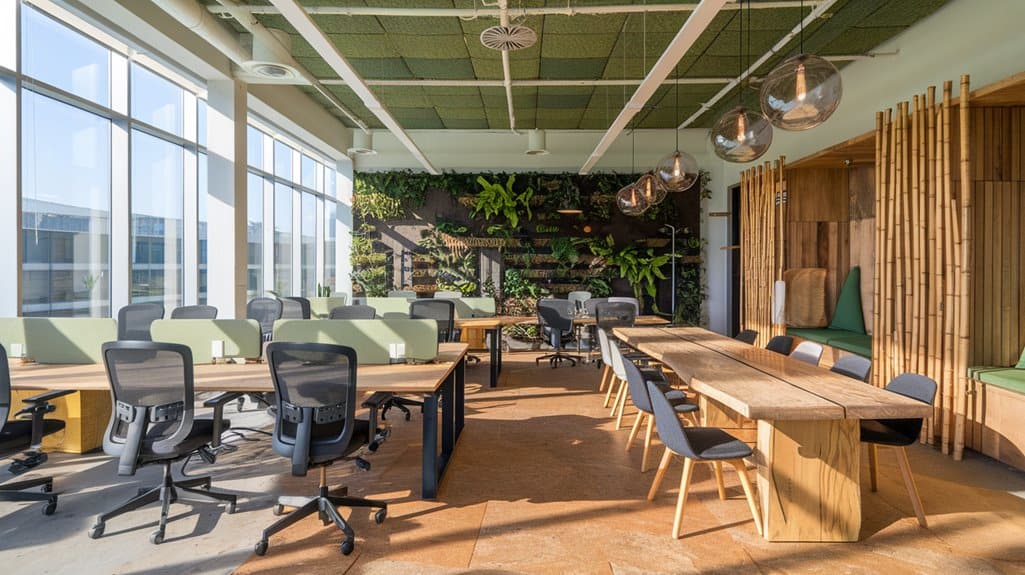
Bright, contemporary office with ergonomic chairs, desks, and colorful artwork, creating an inspiring workspace for creative professionals and team collaboration.
WELL Building Standard v2: The Health Half of the Equation
LEED addresses environmental sustainability. WELL focuses on human health and wellness. Understanding both creates specification synergies that benefit projects pursuing dual certification.
How WELL v2 Changes Material Vetting
WELL v2 introduced a dedicated Materials concept separating material health considerations from the Air concept. This organizational change reflects growing recognition that material selection directly impacts occupant wellness.
The Materials concept includes one precondition and multiple optimization features:
Feature X10: Volatile Compound Reduction targets hazardous VOCs and SVOCs (semi-volatile organic compounds) in building materials. Products must demonstrate compliance through emissions testing.
Feature X11: Long-Term Emission Control regulates emissions from materials that off-gas over extended periods—furniture, flooring, millwork, casework. These materials undergo chamber testing simulating months of in-service conditions.
Feature X12: Short-Term Emission Control focuses on rapidly emitting materials like paints, adhesives, sealants, and coatings. These products typically emit most VOCs within days or weeks of application.
VOC Thresholds That Make Sense (Finally)
Previous health guidance suggested indoor air should contain no more than 500 µg/m³ total VOCs with no single compound exceeding 250 µg/m³. That approach had problems: it treated all VOCs as equally harmful despite vastly different toxicity levels.
WELL v2 adopted individual compound limits based on actual health science. Carbon tetrachloride gets extremely low limits due to high toxicity. Isopropyl alcohol allows higher concentrations because it poses less health risk at typical exposure levels.
This science-based approach better protects occupants while giving designers clearer guidance on which materials pose genuine health concerns versus which simply emit detectable but benign compounds.
Long-Term vs. Short-Term Emitters: Specification Strategies
Understanding emission timing helps you prioritize material selection:
Long-Term Emitters (months to years):
- Furniture and casework
- Flooring systems
- Wall coverings
- Composite wood panels
These materials continuously contact occupants throughout the building’s life. Prioritize low-emission options even if initial costs run slightly higher. The occupant exposure duration justifies the investment.
Short-Term Emitters (days to weeks):
- Paints and coatings
- Adhesives and sealants
- Caulking and gaskets
- Installation consumables
While these emit more intensely initially, emissions drop rapidly. Proper ventilation during and immediately after installation mitigates exposure. Still choose low-VOC options, but recognize you have more flexibility here than with long-term emitters.
Circular Economy Meets Commercial Design
Circular economy principles are migrating from theory to practical implementation. Understanding these concepts positions you to capture emerging LEED credits and future-proof your projects.
Design for Disassembly: Five Principles That Work
Design for disassembly (DfD) enables buildings and components to be deconstructed rather than demolished, recovering material value at end-of-life:
1. Simplify Component Connections: Use mechanical fasteners (bolts, screws, clips) instead of permanent adhesives wherever possible. Minimize different fastener types to simplify disassembly tooling.
2. Select Separable Materials: Avoid mixed-material assemblies that can’t be separated for recycling. Mono-material components simplify material recovery.
3. Enable Easy Access: Position fasteners where tools can reach them. Design logical disassembly sequences. Document connection types and locations.
4. Incorporate Modularity: Standardized component sizes enable reuse across projects. Interchangeable parts extend service life through selective replacement.
5. Create Material Passports: Document material composition, assembly methods, disassembly instructions, and recycling information. QR codes on components link to digital documentation.
Real-world example: Park 20|20 in the Netherlands documents every material in digital passports. The entire development uses reversible connections enabling future adaptation or complete material recovery.
Material Passports + Digital Documentation
Material passports combine product information, assembly details, and environmental data into accessible digital format:
Essential Passport Contents:
- Material composition and quantities
- Manufacturer information and contact
- Assembly and disassembly instructions
- Environmental impact data (embodied carbon, EPDs)
- Maintenance requirements and service life
- Recycling and disposal guidance
BIM (Building Information Modeling) platforms increasingly integrate material passport functionality, linking 3D models directly to material documentation. This integration streamlines LEED documentation while creating permanent project records.
End-of-Life Planning That Protects Project Value
Thinking about end-of-life during design phase seems premature until you consider the economics:
Materials with documented recovery value command higher resale prices. Modular construction systems leased rather than sold create ongoing revenue streams. Buildings designed for deconstruction avoid demolition costs while recovering material value.
Progressive developers are calculating net present value of material recovery decades in the future. When those calculations influence design decisions today, circular economy transitions from aspiration to financial reality.
Documentation Requirements: What to Collect + When
Sustainable material specification generates documentation demands. Systematic collection throughout the design process prevents last-minute scrambles during LEED submission.
EPDs, HPDs, and Declare Labels Demystified
Environmental Product Declarations (EPDs): Quantified lifecycle environmental impacts. Required for LEED Materials & Resources credits. Validity typically 5 years.
Health Product Declarations (HPDs): Ingredient inventory with hazard screening. Voluntary disclosure supporting LEED and WELL credits. Full disclosure preferred over screened or self-declared levels.
Declare Labels: Living Building Challenge compliance verification. Confirms Red List avoidance and ingredient transparency. Particularly valuable for projects pursuing ambitious sustainability certifications.
Create project folders organized by material category. As manufacturers provide documentation, file it immediately with clear naming conventions: [Manufacturer][Product][DocumentType]_[Date].pdf
FSC Certificates, Cradle to Cradle, and GREENGUARD
Additional certifications strengthen material credentials:
FSC Certificates: Chain of custody verification for wood products. Must match project procurement documentation showing FSC wood specified and delivered.
Cradle to Cradle: Multi-attribute certification evaluating material health, material reutilization, renewable energy use, water stewardship, and social fairness. Products achieve Bronze, Silver, Gold, or Platinum levels.
GREENGUARD: Chemical emissions testing demonstrating low VOC emissions. GREENGUARD Gold meets more stringent standards suitable for schools and healthcare.
LEVEL: Business and Institutional Furniture Manufacturers Association (BIFMA) sustainability certification combining environmental and social impacts.
Building Your Material Documentation Library
Start documentation collection during schematic design:
Early Design Phase:
- Identify target LEED/WELL credits requiring material documentation
- Establish documentation requirements and responsibilities
- Request preliminary EPDs and certifications from manufacturers
- Create shared documentation repository (cloud-based folder structure)
Design Development:
- Verify EPD currency and third-party verification
- Collect cut sheets, specifications, and installation instructions
- Document material quantities and cost estimates
- Cross-reference documentation against credit requirements
Construction Documentation:
- Finalize material selections with complete documentation
- Include documentation requirements in specifications
- Establish contractor submittal requirements
- Schedule pre-installation verification meetings
Construction Administration:
- Review submittals for documentation completeness
- Verify delivered materials match specifications
- Photograph installations for verification
- Maintain substitution documentation trail
This systematic approach prevents the common scenario where projects lose credits because documentation exists but wasn’t properly collected and organized.
Practical Implementation: From Theory to Spec Sheet
Understanding sustainable material requirements is one thing. Executing them smoothly through design, procurement, and installation is another. Here’s how to bridge that gap.
Early Design Phase: Setting Sustainable Material Goals
Begin conversations about sustainable materials during project kickoff:
Establish Certification Targets: Are you pursuing LEED? WELL? Living Building Challenge? What certification level? These decisions determine documentation depth and material requirements.
Set Embodied Carbon Budget: Even if not pursuing certification, establishing embodied carbon targets drives material decisions. Use industry benchmarks to set achievable goals.
Identify Material Priorities: Which material categories offer biggest environmental impact reduction opportunities? Where do performance or budget constraints limit options?
Engage Stakeholders: Contractor input early identifies constructability concerns. Manufacturer engagement reveals product capabilities and documentation availability.
Material Selection Process: Vetting + Approving Options
Create evaluation matrix comparing options across criteria:
- Embodied carbon (from EPDs or databases)
- Recycled/renewable content percentage
- VOC emissions data
- Required certifications (FSC, GREENGUARD, etc.)
- Cost (initial and lifecycle)
- Lead time and availability
- Aesthetic fit with design intent
Shortlist materials excelling across multiple criteria. Request samples for physical evaluation. Verify documentation completeness before finalizing specifications.
Contractor Coordination: Ensuring Compliance Through Installation
Clear communication prevents substitutions that undermine sustainability goals:
Pre-Bid:
- Include sustainability requirements in project manual
- Specify documentation submittal requirements
- Establish approval processes for proposed equals
- Clarify that sustainable material specifications aren’t negotiable value engineering targets
During Construction:
- Review submittals promptly—delays encourage unauthorized substitutions
- Verify material deliveries match approved submittals
- Inspect installations for proper techniques
- Document deviations immediately
Post-Construction:
- Compile final documentation for certification submission
- Verify quantities installed match design intent
- Photograph completed installations
- Gather warranty and maintenance information
Common Pitfalls + How to Avoid Them
Learn from others’ mistakes rather than making your own.
Greenwashing Red Flags in Material Marketing
Manufacturers make environmental claims ranging from meticulously verified to completely fabricated. Watch for:
Vague Claims: “Eco-friendly” and “green” without supporting data mean nothing. Demand quantified impacts from third-party sources.
Misleading Certifications: Obscure “certifications” from organizations that exist primarily to issue certifications should raise suspicion. Stick with recognized programs like FSC, GREENGUARD, and legitimate EPD program operators.
Cherry-Picked Attributes: “Made from recycled materials” might be true while ignoring toxic manufacturing processes or poor durability requiring frequent replacement.
Expired Documentation: EPDs and certifications expire. Verify currency before finalizing specifications.
When “Recycled Content” Doesn’t Count for Credits
LEED defines specific recycled content requirements:
Post-Consumer vs. Post-Industrial: Post-consumer recycled content (material that completed its intended use) counts fully. Post-industrial content (manufacturing scrap) counts at 50% value.
Assembly vs. Component: For assemblies containing multiple materials, calculate recycled content by weight or cost of assembly, not just the recycled component.
Documentation Requirements: Manufacturer certification or third-party verification required. Verbal claims insufficient for credit documentation.
Timeline Mistakes That Derail LEED Certification
Starting Documentation Late: Beginning documentation collection during construction administration creates impossible timelines. Start during schematic design.
Assuming Products Have EPDs: Many products don’t. Verify EPD availability before specifying materials on the critical path.
Underestimating Review Time: Third-party certification review processes take weeks or months. Build buffer time into project schedules.
Ignoring Substitution Impact: Every material substitution requires re-evaluating sustainability documentation. Establish clear protocols for handling substitutions.
Cost Considerations: The Real ROI of Sustainable Materials
Budget concerns legitimately influence material selection. Understanding where sustainable options cost more—and where they don’t—enables intelligent value engineering.
Upfront Premium vs. Lifecycle Value
Some sustainable materials carry initial cost premiums. Smart specification focuses on lifecycle value:
Materials Worth the Premium:
- Low-VOC finishes in occupied spaces (improved occupant health and productivity)
- Durable flooring with extended warranties (reduced replacement frequency)
- FSC-certified millwork (brand value and certification credits)
Materials With Minimal Premium:
- Recycled content metals (often cost-competitive with virgin)
- LED lighting with controls (energy savings pay back rapidly)
- Water-efficient fixtures (immediate utility savings)
Materials Actually Cheaper:
- TFL vs. wood veneer (significant labor savings)
- Certain regional materials (reduced transportation costs)
- Durable materials vs. frequent replacement (lifecycle cost advantage)
Which Sustainable Upgrades Deliver Immediate Payback?
Focus first on materials where sustainability and economics align:
Energy-Efficient Systems: Lighting, controls, and HVAC upgrades typically pay back within 3-7 years through utility savings.
Water-Efficient Fixtures: Reduced water and sewer costs begin immediately. ROI often under 5 years.
Durable Finishes: Higher-quality flooring, wall protection, and furniture cost more initially but eliminate replacement cycles within warranty periods.
Modular Systems: While potentially more expensive initially, modular casework, partitions, and furniture allow reconfiguration without replacement, protecting capital investment.
Convincing Clients: The Business Case for Green Materials
Translate environmental benefits into business language:
Certification Value: LEED and WELL certifications command rental rate premiums of 3-5% and improved tenant retention.
Brand Positioning: Sustainability credentials attract and retain top talent. Employee recruitment and retention costs dwarf material selection price differences.
Regulatory Future-Proofing: Embodied carbon regulations are coming. Materials meeting 2025 standards avoid expensive retrofits when regulations tighten.
Occupant Productivity: Improved indoor air quality and wellness features increase productivity. A 1% productivity gain in an office setting pays for sustainable material premiums many times over.
Insurance and Risk: Buildings designed for disassembly, using non-toxic materials, and documenting sustainable practices reduce liability exposure and may qualify for preferential insurance rates.
Tools + Resources for Sustainable Specification
Don’t reinvent wheels. These free and low-cost resources accelerate sustainable specification.
EPD Databases Worth Bookmarking
EC3 Tool (Embodied Carbon in Construction Calculator): Free tool developed by Building Transparency containing the world’s largest EPD database plus material comparison and benchmarking capabilities. Essential for embodied carbon assessment.
EPD Hub: Aggregates EPDs from multiple program operators in searchable database.
Manufacturer Websites: Progressive manufacturers now provide EPD libraries with advanced filtering. Check Wilsonart, Interface, Armstrong, and other leading manufacturers.
LCA Software That Designers Actually Use
Tally: Revit plugin enabling real-time lifecycle assessment during BIM design. Subscription-based but integrates seamlessly with design workflow.
OneClickLCA: Cloud-based LCA tool with material libraries and automated calculation. Good for projects pursuing multiple certifications.
Athena Impact Estimator: Free tool for whole-building lifecycle assessment. Less granular than commercial options but sufficient for early design decisions.
Industry Organizations Offering Free Guidance
Carbon Leadership Forum: Research, tools, and best practices for embodied carbon reduction. Extensive free resources including the LCA Practice Guide.
Mindful MATERIALS: Transparency-focused library with health and environmental attribute data.
International Living Future Institute: Living Building Challenge resources including Red List, Declare database, and material guidance.
USGBC Education: Free webinars, case studies, and credit interpretation guidance for LEED.
International WELL Building Institute: WELL resources including feature overviews and implementation guidance.
FAQs About Sustainable Material Selection
Q: Do all materials need EPDs for LEED v5 certification?
No. LEED requires EPDs for at least 20 permanently installed products from 5 manufacturers to earn credit. Additional products boost credit achievement, but you don’t need EPDs for every material. Focus on high-impact materials like flooring, casework, walls, and structural components first.
Q: How much does sustainable material selection increase project costs?
Studies show green building costs 0-4% more initially, with many projects achieving sustainability goals at no additional cost through intelligent value engineering. Lifecycle costs typically run 10-30% lower due to reduced energy, water, and maintenance expenses plus improved durability.
Q: Can you retrofit existing buildings to meet 2025 standards?
Yes. Interior renovations offer excellent opportunities for sustainable material implementation. Focus on finish materials, furniture, and fixtures where you exert the most control. Whole-building certification requires mechanical systems upgrades, but interior-focused credits remain accessible through thoughtful material selection.
Q: What’s the difference between embodied and operational carbon?
Embodied carbon represents emissions from material manufacturing, transportation, and installation—the carbon “baked into” the building before occupancy. Operational carbon comes from energy consumed during building use—heating, cooling, lighting, equipment. LEED v5 addresses both comprehensively.
Q: Are bio-based materials durable enough for commercial projects?
Absolutely. Modern bio-based materials like bamboo flooring, cork wall treatments, and agricultural-residue panels meet or exceed commercial durability standards when properly specified for their application. Verify warranties and performance testing data, but don’t assume bio-based means fragile—many outperform conventional alternatives.