
Restaurant Surface Materials: A Designer’s Guide to Food Safety Compliance

Restaurant surface materials play a far larger role in food-safety outcomes than most designers realize**.** A single failed health inspection can shutter a restaurant for days, torch its online reputation overnight, and send your client hunting for someone to blame—often the designer who specified that gorgeous-but-porous backsplash behind the prep line. We’ve seen it happen. A boutique taco concept in Austin lost $47,000 in revenue during a three-day closure because the health inspector flagged unsealed grout joints behind the salsa station. The owner didn’t blame the contractor. She blamed the designer who “should have known better.”
Here’s the truth we share with every hospitality client: surface materials aren’t just about aesthetics or durability. They’re compliance tools. When you specify the right materials in the right zones, you build a restaurant that sails through inspections. When you don’t, you build a liability.
In this article, you’ll learn:
- Why health inspectors scrutinize surface materials as closely as food-handling practices
- How the FDA Food Code and NSF International standards define compliant surfaces
- Which material properties earn a passing grade—and which trigger instant violations
- Zone-by-zone specification guidance from the dining room to the dish pit
- How Thermally Fused Laminate, stainless steel, and solid surface options stack up for compliance
- The three specification mistakes that cause the most health-code failures
- A pre-specification checklist you can use on your next restaurant project

Why Surface Selection Is a Food-Safety Decision (Not Just an Aesthetic One)
We talk to designers every week who treat material selection as a purely aesthetic exercise. They choose finishes for color, texture, and brand alignment—then hope the materials perform under commercial kitchen conditions. That approach works fine in corporate offices. In restaurants, it’s a recipe for disaster.
The Real Cost of a Failed Inspection
Health inspections carry consequences that extend far beyond the violation itself. According to research from the National Bureau of Economic Research, publicly posted health inspection grades influence restaurant compliance and can materially affect customer behavior and revenue — establishments that improve their ratings benefit from higher demand.
Critical violations related to surfaces can trigger immediate closure. The FDA Food Code classifies improperly maintained food-contact surfaces as a priority violation. That designation means the health inspector can shut the doors until the problem is corrected.
We worked with a fast-casual client in Denver who faced this exact scenario. Their original designer specified a natural stone countertop in the sandwich prep area. The stone looked stunning. It also absorbed moisture, harbored bacteria, and failed inspection eighteen months after opening. The retrofit cost $23,000—plus five days of lost revenue during the work.
Where Designers Fit in the Compliance Chain
Designers occupy a unique position in restaurant development. We sit between the client’s vision and the health inspector’s checklist. That positioning gives us power—and responsibility.
When we specify materials, we’re making compliance decisions on our client’s behalf. Most restaurateurs don’t know that the FDA Food Code requires food-contact surfaces to be “smooth, easily cleanable, and durable.” They trust us to know. When we fail to specify compliant materials, we fail that trust.
The good news? Mastering food-safe material specification isn’t complicated. It just requires understanding the regulatory framework, knowing which material properties matter, and matching the right products to the right zones.

Regulatory Framework Every Designer Should Know
Restaurant surface compliance doesn’t rest on a single document. Three layers of regulation govern what you can and cannot specify. Understanding each layer helps you navigate client conversations, contractor questions, and inspector interactions with confidence.
FDA Food Code Essentials
The FDA Food Code serves as the model code that most state and local jurisdictions adopt. It’s updated every four years and represents the federal government’s best-practice guidance for retail food safety.
Chapter 4 of the Food Code covers equipment, utensils, and linens. Section 4-101 establishes the baseline for food-contact surfaces:
- Surfaces must be smooth and easily cleanable
- Materials must be safe under intended use conditions
- Surfaces must be durable, corrosion-resistant, and nonabsorbent
- Finished surfaces must be free of breaks, open seams, cracks, and chips
These requirements sound straightforward. In practice, they eliminate entire material categories from consideration in food-prep zones.
NSF International Certification Decoded
NSF International sets voluntary standards that carry enormous weight with health inspectors. When a product earns NSF certification, it signals third-party verification of food-safety compliance.
For designers, two NSF standards matter most:
- NSF/ANSI 2 covers food equipment and food-contact surfaces. Products certified to this standard have been tested for cleanability, material safety, and design integrity.
- NSF/ANSI 51 covers food-equipment materials. It verifies that surface materials won’t leach harmful substances into food under normal use conditions.
We recommend specifying NSF-certified products wherever possible. Certification doesn’t guarantee you’ll pass inspection, but it provides documented proof that your material choices meet recognized safety standards.
Navigating State and Local Health Codes
Here’s where compliance gets tricky. The FDA Food Code is a model—not a mandate. Each state adopts and adapts the code according to local priorities. County and city health departments may add additional requirements.
We always advise clients to request a pre-design meeting with the local health department. These meetings accomplish three things:
- They establish a relationship with the inspector who’ll evaluate the finished space
- They surface jurisdiction-specific requirements that might override general guidance
- They create a paper trail documenting that the design team sought compliance input
One client in California discovered during a pre-design meeting that their county required antimicrobial surface treatments in all prep areas. That requirement didn’t appear in the state code. Without the meeting, we would have missed it.

The Four Non-Negotiable Material Properties
Regardless of zone or jurisdiction, compliant restaurant surfaces share four properties. We evaluate every material against these criteria before adding it to a specification.
Nonporous Performance
Porous materials absorb moisture. Moisture harbors bacteria. Bacteria cause foodborne illness. This chain of causation explains why health codes prohibit porous surfaces in food-contact zones.
Nonporous performance means the material’s surface won’t absorb liquids, grease, or food particles. True nonporosity requires both an impervious surface and sealed edges. A solid-surface countertop with exposed particleboard edges isn’t nonporous—it’s a violation waiting to happen.
Cleanability Under Commercial Conditions
“Easily cleanable” means more than wipe-down friendly. Commercial kitchens use aggressive cleaning protocols:
- High-temperature sanitizing solutions
- Quaternary ammonium compounds
- Chlorine-based sanitizers
- Pressure washing in some zones
Materials must withstand these protocols without degrading, staining, or losing their nonporous properties. We’ve seen beautiful matte finishes fail within months because the surface couldn’t tolerate daily sanitizer exposure.
Durability Against Thermal and Chemical Stress
Commercial kitchens stress surfaces in ways residential spaces never do. Hot pans, thermal shock from ice, acidic ingredients, and chemical sanitizers create a punishing environment.
Durable materials maintain their integrity under these conditions. They resist cracking from thermal cycling. They don’t delaminate when exposed to moisture. They won’t corrode when acidic marinades splash onto the surface.
Resistance to Moisture and Microbial Growth
Even nonporous surfaces can support microbial growth if their design creates harboring points. Seams, joints, edges, and hardware cutouts all present opportunities for moisture accumulation and bacterial colonization.
We evaluate materials not just for their surface properties but for how they’ll be fabricated and installed. Seamless installations outperform jointed ones. Integrated backsplashes outperform applied ones. Coved junctions between counters and walls outperform square corners.

Zone-by-Zone Specification Guide
Restaurant spaces divide into distinct zones, each with different exposure conditions and compliance requirements. Material specifications should reflect these differences.
Front-of-House Surfaces (Dining, Host Stands, Bars)
Front-of-house surfaces generally face lighter regulatory scrutiny than kitchen areas. However, any surface where food is served or consumed still falls under health-code jurisdiction.
Bar tops require special attention. Bartenders handle ready-to-eat garnishes, cut fruit, and ice. Health inspectors evaluate bar surfaces as food-contact zones when food preparation occurs there.
For dining tables, host stands, and non-food-contact bar areas, we often specify decorative materials that wouldn’t pass muster in the kitchen. The key distinction is food contact. A dining table surface that holds plated food doesn’t face the same requirements as a prep surface where raw ingredients are processed.
Back-of-House and Kitchen Prep Areas
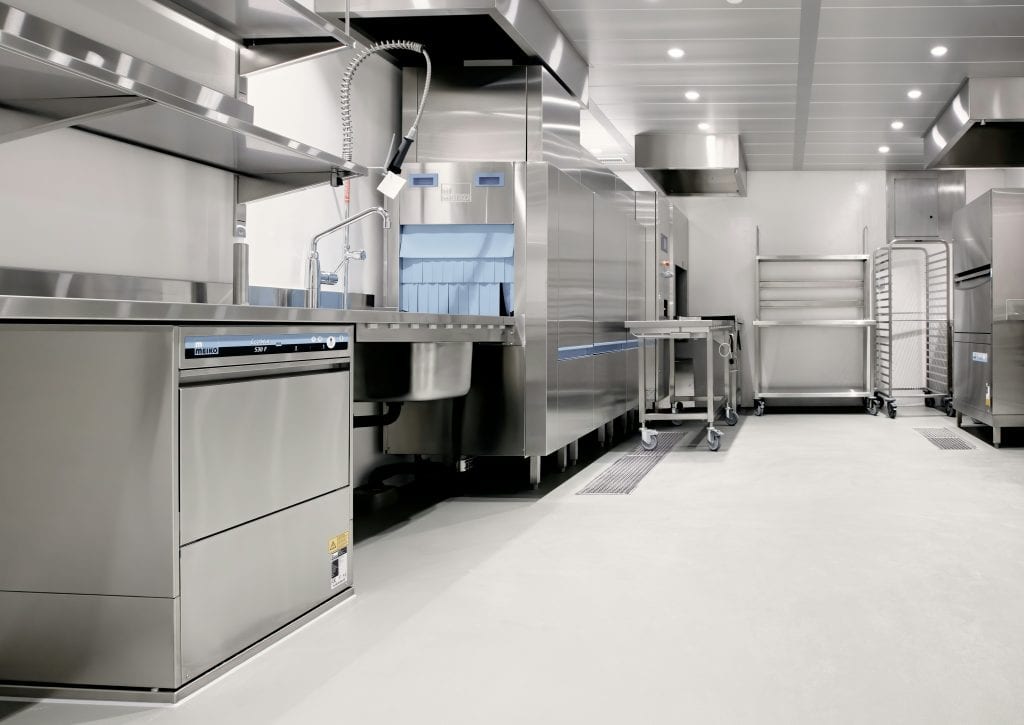
This zone demands the strictest compliance attention. Every surface where food is prepared, processed, or stored must meet FDA Food Code requirements for smoothness, cleanability, and nonporosity.
We specify stainless steel for most prep counters and work surfaces. For cabinetry and vertical surfaces, Thermally Fused Laminate from KML Designer Finishes offers an excellent compliance profile. TFL’s factory-sealed surface resists moisture penetration and tolerates commercial cleaning protocols. It also provides design flexibility that solid stainless environments lack.
One case study worth noting: a farm-to-table concept in Portland wanted exposed wood shelving in their open kitchen. Health codes prohibited unsealed wood in food-prep areas. We solved the problem by specifying TFL panels with a realistic wood-grain finish. The client got the aesthetic they wanted. The health inspector got compliant surfaces.
Warewashing and Sanitation Zones
Dish pits and warewashing areas face constant moisture exposure. Water, steam, and chemical sanitizers create an extremely demanding environment.
Stainless steel dominates this zone for good reason. It handles moisture, heat, and chemicals without degrading. For adjacent walls and cabinetry, we specify marine-grade materials or TFL with enhanced moisture-resistant cores.
Flooring in warewashing zones requires special attention. We specify quarry tile or sealed concrete with proper drainage slopes. Standing water creates slip hazards and sanitation problems. The floor system must move water toward drains efficiently.
Dry Storage and Walk-In Environments
Dry storage areas face fewer compliance requirements than wet zones but still demand appropriate material selection. Shelving must be smooth, cleanable, and corrosion-resistant. Wire shelving with epoxy coating meets these requirements. Solid shelving with sealed surfaces works equally well.
Walk-in coolers and freezers present unique challenges. Materials must tolerate temperature extremes, condensation during defrost cycles, and regular washdown cleaning. Most walk-in manufacturers integrate compliant interior surfaces, but designers should verify material specifications rather than assuming compliance.
Material Options That Pass Inspection
Four material categories dominate compliant restaurant design. Each offers distinct advantages and limitations.
Thermally Fused Laminate (TFL)
TFL earns our recommendation for most restaurant cabinetry and many countertop applications. The manufacturing process fuses decorative paper directly to the substrate under heat and pressure, creating a sealed surface without applied adhesives.
Advantages of TFL for restaurant applications:
- Factory-sealed surfaces resist moisture penetration
- Broad design options including solid colors, woodgrains, and patterns
- Cost-effective compared to solid surface or stainless alternatives
- Tolerates commercial cleaning protocols when properly specified
- Available with enhanced moisture-resistant cores for wet-zone adjacencies
KML Designer Finishes produces TFL products specifically engineered for commercial applications. Their surfaces meet the cleanability and durability requirements health inspectors evaluate.
We’ve specified TFL in more than thirty restaurant projects over the past five years. Not one has triggered a surface-related health violation.
Stainless Steel
Stainless steel remains the gold standard for food-contact prep surfaces. NSF certification is readily available. Cleanability is unquestionable. Durability is exceptional.
The material’s limitations are primarily aesthetic and economic. Stainless steel creates a clinical atmosphere that conflicts with some design concepts. It’s also expensive, particularly for custom fabrication.
We use stainless steel for prep counters, equipment surfaces, and warewashing areas. In front-of-house applications, we typically limit stainless to accent elements rather than primary surfaces.
Solid Surface and Engineered Quartz
Solid surface materials like Corian and engineered quartz products offer seamless fabrication options that eliminate joint concerns. Their nonporous surfaces clean easily and resist bacterial growth.
These materials work well for food-contact counters in display kitchens and open-concept designs where aesthetics matter. They cost more than TFL but less than custom stainless fabrication for comparable applications.
One caution: not all solid surface products carry NSF certification. We verify certification status before specifying any solid surface in food-contact applications.
Tile, Epoxy, and Specialty Coatings
Tile works well for walls and floors but presents challenges for horizontal food-contact surfaces. Grout joints create potential harboring points for bacteria. If you specify tile in food-prep areas, use epoxy grout and maintain narrow joint widths.
Epoxy coatings provide seamless protection for concrete floors and walls. Properly installed epoxy creates a nonporous, cleanable surface that meets health-code requirements. The key phrase is “properly installed.” Poor installation leads to peeling, cracking, and failed inspections.
Specification Mistakes That Trigger Violations
We’ve compiled this list from conversations with health inspectors, post-inspection remediation projects, and our own early-career learning experiences.
Porous Materials in Wet Zones
Natural stone, unsealed wood, and unglazed tile have no place in food-prep environments. These materials absorb moisture regardless of how carefully they’re maintained. Health inspectors will flag them every time.
We see this mistake most often when clients fall in love with a material during the concept phase. They see beautiful marble in a magazine spread and insist on incorporating it. Our job is to redirect that enthusiasm toward compliant alternatives that achieve similar aesthetic goals.
Inadequate Edge Banding and Seam Sealing
A countertop’s surface might be perfectly nonporous while its edges absorb moisture like a sponge. Edge banding and seam sealing matter as much as surface selection.
For laminate and TFL applications, we specify factory-applied edge banding rather than field-applied alternatives. Factory application ensures consistent adhesion and eliminates the variability that field conditions introduce.
At seams, we require silicone sealant compatible with food-contact applications. Seams should be tight, fully sealed, and located away from direct food-contact areas whenever possible.
Ignoring Chemical Compatibility
The sanitizing products that kill bacteria also destroy some surface materials. Chlorine bleach degrades certain laminate surfaces. Quaternary ammonium compounds can discolor natural stone. Acidic cleaners etch marble and limestone.
Before finalizing any specification, we verify chemical compatibility with the cleaning protocols the restaurant will use. This step prevents the scenario where a surface looks perfect on opening day and deteriorates visibly within months.
Your Pre-Specification Compliance Checklist
We use this checklist on every restaurant project. Feel free to adapt it for your practice.
- Confirm which edition of the FDA Food Code your jurisdiction has adopted
- Schedule a pre-design meeting with the local health department
- Map all food-contact surfaces and identify applicable requirements for each
- Verify NSF certification for all food-contact surface products
- Confirm edge-banding and seam-sealing details in countertop specifications
- Document chemical compatibility between surfaces and intended cleaning protocols
- Specify coved junctions at wall-counter intersections in prep areas
- Review walk-in cooler and freezer interior surface specifications
- Include surface-compliance requirements in contractor scope documents
- Request material submittals with certification documentation before installation begins
FAQs
What makes a surface “food-contact” under health codes? Any surface that directly touches food or food ingredients during preparation, processing, or storage qualifies as food-contact. This includes prep counters, cutting boards, shelving that holds unwrapped food, and equipment surfaces.
Can natural wood be used anywhere in a restaurant kitchen? Health codes permit sealed hardwood cutting boards for specific uses but prohibit unsealed wood in food-prep areas. Decorative wood elements are acceptable in non-food-contact zones with proper finish coatings.
How often do health inspectors evaluate surface materials? Inspectors evaluate surfaces during every routine inspection, typically conducted two to three times annually depending on jurisdiction. Surface condition and compliance factor into the overall inspection score.
Does TFL meet FDA Food Code requirements for restaurant surfaces? Yes. TFL’s sealed, nonporous surface meets FDA requirements for smoothness, cleanability, and durability when properly specified and installed. Edge sealing and moisture-resistant cores enhance compliance in demanding applications.
What happens if a surface fails inspection after the restaurant opens? The inspector issues a violation requiring correction within a specified timeframe. Critical violations may require immediate closure until the problem is fixed. Surface-related corrections often require full replacement of non-compliant materials.