
Green Building Credits: How Your Material Choices Earn LEED Points
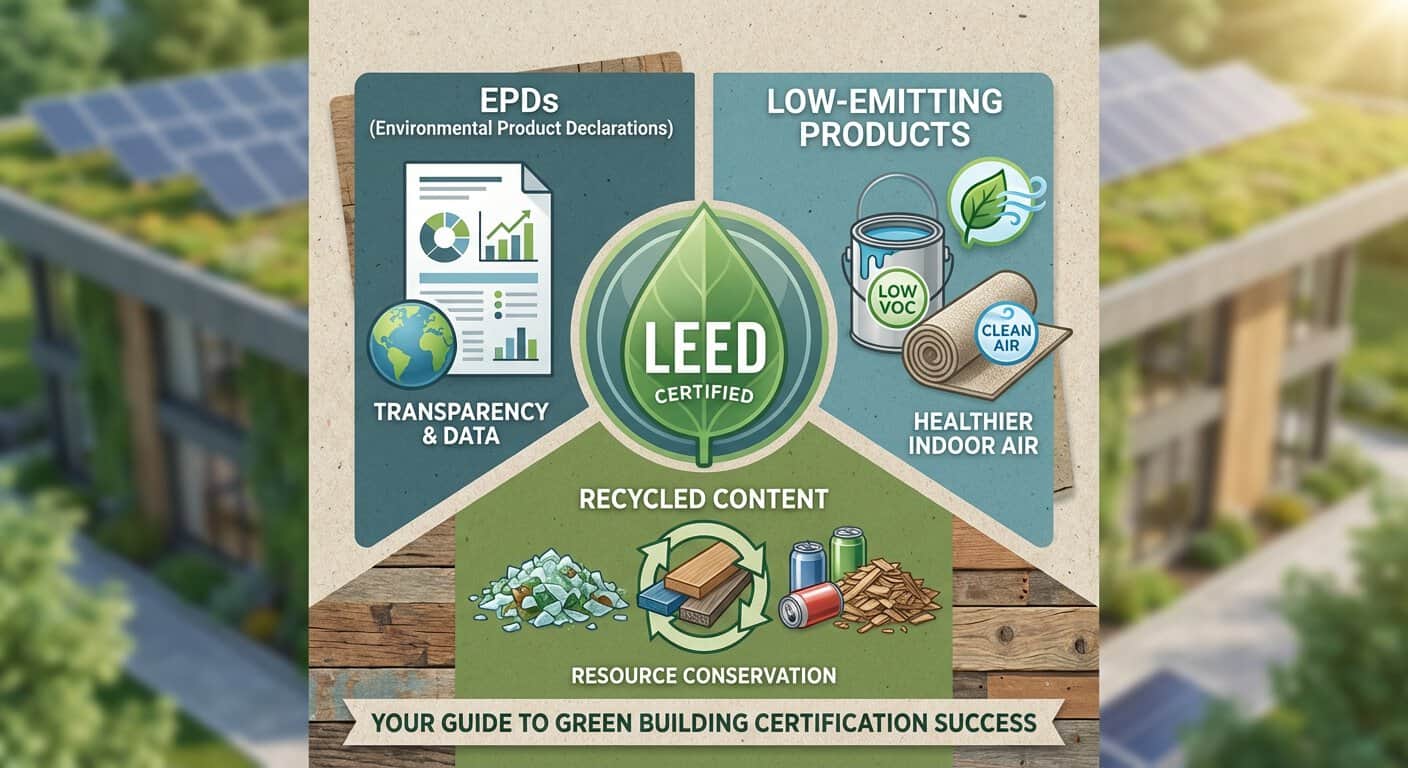
Every material you specify whispers a story to the LEED scorecard—and with the right choices, those whispers add up to a roar of green building credits that elevate projects, impress clients, and pad the bottom line.
Here’s the thing most designers miss: LEED certification isn’t just about solar panels and living walls. The surfaces covering your client’s walls, the laminates wrapping their casework, and the finishes on their millwork all carry hidden point potential. With more than 195,000 LEED-certified projects spanning 29 billion square feet worldwide, according to the U.S. Green Building Council, the demand for designers who understand green building credits has never been higher. And the secret weapon? Strategic material selection.
The Materials and Resources category alone offers up to 13 points. Indoor Environmental Quality credits add several more. Together, your material choices can directly influence 16 or more points on the LEED scorecard. That’s often the difference between Silver and Gold—or Gold and Platinum. This guide breaks down exactly how your specifications translate into certification success.
In this article, you’ll learn:
- How LEED’s point system works and where materials fit into the 110-point puzzle
- Which Materials and Resources credits reward sustainable product choices
- What low-emitting material standards mean for composite wood and surface finishes
- How thermally fused laminate and other surface materials can earn multiple credits simultaneously
- The documentation you need to collect from manufacturers throughout your project
- ROI data that helps you make the business case to clients
Understanding the LEED Points Landscape
Before diving into specific materials, let’s establish how the LEED system actually works. Understanding the framework helps you identify opportunities at every specification decision.
The Four Certification Levels and What They Mean for Your Projects
LEED operates on a 110-point scale. Projects earn points by meeting credit requirements across multiple categories. The points you accumulate determine your certification level.
The four levels break down as follows:
- Certified: 40-49 points
- Silver: 50-59 points
- Gold: 60-79 points
- Platinum: 80+ points
Most commercial clients target Gold or higher. Why? Because Gold certification has become the baseline expectation for Class A office space. It signals quality to tenants and demonstrates corporate sustainability commitments. Platinum projects command premium positioning in competitive markets.
The certification level you achieve directly impacts tenant attraction and retention. Buildings with higher LEED ratings report 4.1% higher occupancy rates. They also command rent premiums up to 20%, according to research from the University of California. Your material choices help determine whether clients reach their target tier.
Where Materials Fit in the 110-Point Puzzle
LEED v4.1 organizes credits into eight categories. Two categories directly reward smart material selection: Materials and Resources (MR) and Indoor Environmental Quality (IEQ).
The eight categories include:
- Location and Transportation
- Sustainable Sites
- Water Efficiency
- Energy and Atmosphere
- Materials and Resources
- Indoor Environmental Quality
- Innovation
- Regional Priority
The Materials and Resources category contains two prerequisites and five credits worth up to 13 points. The Indoor Environmental Quality category includes a Low-Emitting Materials credit worth up to three points. Combined with potential Innovation credits for exceptional performance, materials can influence 16 or more points on your project’s scorecard.
Think of it this way: every surface specification is a vote for or against certification success.
Materials and Resources Credits: Your Direct Path to Points
The MR category rewards projects that reduce environmental impact through thoughtful material selection. Three credit pathways offer the clearest opportunities for designers: Environmental Product Declarations, Sourcing of Raw Materials, and Material Ingredients transparency.
Environmental Product Declarations—The New Currency of Green Design
Environmental Product Declarations have become essential documentation for LEED projects. An EPD is a standardized report that discloses a product’s environmental impact across its lifecycle. Think of it as a nutrition label for building materials.
EPDs must conform to ISO 14044 standards and include at least a cradle-to-gate scope. This means they cover impacts from raw material extraction through manufacturing. Cradle-to-grave EPDs go further but aren’t required.
Option 1 earns one point when projects use at least 20 different permanently installed products from at least five different manufacturers. Products qualify based on their EPD type:
- Product-specific Type III EPD with external verification counts as 1.5 products
- Industry-wide Type III EPD counts as 1 product
- Products with cradle-to-gate life cycle assessments count as 1 product
Option 2 earns an additional point for multi-attribute optimization. Projects can qualify by demonstrating life-cycle impact reductions on 10% of permanently installed products by cost. Alternatively, projects can use at least 10 qualifying products from at least three manufacturers that show embodied carbon reductions.
The practical takeaway? Request EPDs from every manufacturer you specify. Those documents stack up toward your 20-product threshold faster than you might expect.
Sourcing of Raw Materials—Rewarding Responsible Extraction
This credit rewards projects that use responsibly sourced materials. Points come from three main pathways: recycled content, bio-based materials, and third-party certified wood products.
Recycled content calculations follow a specific formula. The sum of post-consumer recycled content plus one-half of pre-consumer recycled content must constitute at least 25% of permanently installed products by cost.
Here’s how the math works:
- Post-consumer recycled content counts at 100% of its value
- Pre-consumer recycled content counts at 50% of its value
For example, a particleboard substrate with 92% pre-consumer recycled wood fiber contributes 46% toward the recycled content threshold (92% × 0.5 = 46%). When that substrate forms the core of casework throughout a project, the credit contribution adds up quickly.
Bio-based materials and products from responsibly managed forests also contribute. FSC-certified wood products count toward certified materials requirements. Products sourced within 100 miles of the project site receive a powerful bonus: they’re valued at 200% of their base contributing cost.
Material Ingredients Transparency Through HPDs
Health Product Declarations provide chemical ingredient transparency. Where EPDs focus on environmental impact, HPDs disclose what’s actually in the product. LEED rewards this transparency.
Projects using products with HPDs can contribute to the Material Ingredients credit. Third-party verified HPDs count as 1.5 products toward credit thresholds. Standard HPDs count as one product.
The credit also rewards projects that minimize persistent, bioaccumulative, and toxic chemicals. Products screened through programs like Cradle to Cradle certification or REACH compliance demonstrate this commitment.
When evaluating products, ask manufacturers for both EPDs and HPDs. Having both documents maximizes your credit contribution from a single specification.
Indoor Environmental Quality: Low-Emitting Materials That Protect Occupants and Earn Points
The IEQ category focuses on occupant health and comfort. The Low-Emitting Materials credit specifically rewards products that minimize volatile organic compound emissions and other indoor air pollutants.
VOC Limits by Product Category
LEED establishes VOC emission thresholds across seven product categories. Each category has specific compliance percentages and testing standards.
Paints and coatings must meet VOC limits established by California Air Resources Board (CARB) standards. At least 75% must meet VOC emissions evaluation requirements, and 100% must meet VOC content limits.
Adhesives and sealants follow SCAQMD Rule 1168 standards. The same 75% emissions threshold applies.
Flooring carries a higher threshold. At least 90% must meet VOC emissions evaluation, qualify as inherently nonemitting, or consist of salvaged and reused materials.
Wall panels and ceilings must meet 75% and 90% thresholds respectively. Products can qualify through emissions testing, inherently nonemitting status, or salvage.
Composite wood requires special attention. At least 75% must meet formaldehyde emissions evaluation requirements or qualify as salvaged materials.
Furniture must meet ANSI/BIFMA Standard Method M7.1-2011. Again, 75% compliance is required.
Understanding these thresholds helps you make specification decisions that support certification goals.
Composite Wood and Formaldehyde Compliance
Composite wood products receive extra scrutiny under LEED. Formaldehyde emissions from particleboard, MDF, and plywood can degrade indoor air quality. Two compliance designations indicate products meet the strictest standards.
No Added Formaldehyde (NAF) products use resin systems that don’t incorporate formaldehyde chemistry. The manufacturing process excludes formaldehyde entirely.
Ultra-Low Emitting Formaldehyde (ULEF) products may contain trace formaldehyde but emit at levels far below regulatory limits.
Both designations satisfy LEED requirements. The key regulatory frameworks are EPA TSCA Title VI and CARB ATCM Phase II. These regulations establish maximum emission limits of 0.09 ppm for particleboard and 0.11 ppm for MDF.
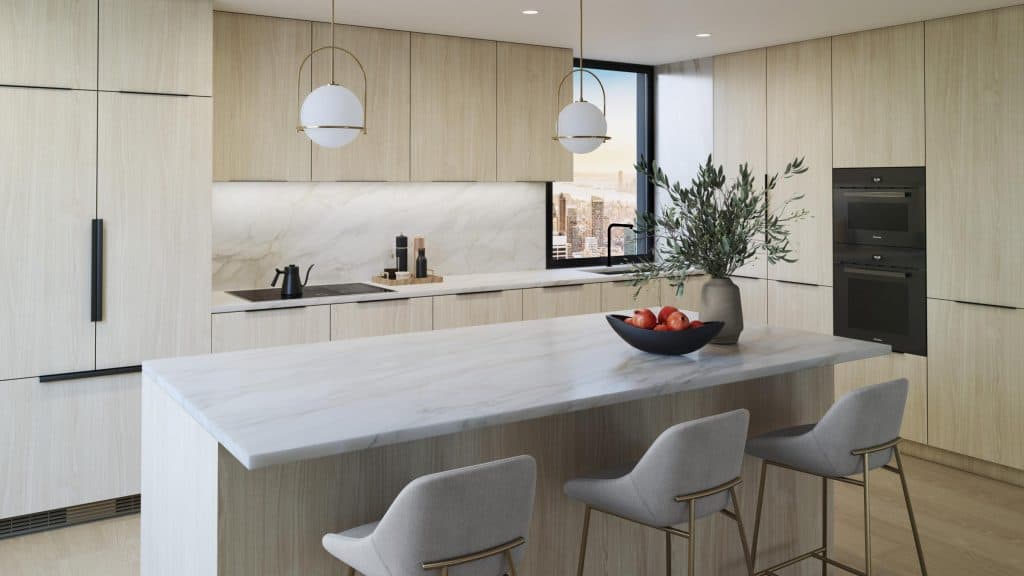
Here’s where surface material selection becomes strategic: thermally fused laminate products inherently meet NAF requirements. The melamine resin system used in TFL manufacturing doesn’t incorporate formaldehyde. It cures clear without releasing VOCs. This makes TFL an automatic qualifier for low-emitting material credits.
GREENGUARD Gold—The Gold Standard for Indoor Air Quality
GREENGUARD certification provides third-party verification of low chemical emissions. GREENGUARD Gold represents the most stringent tier, requiring total VOC emissions not to exceed 220 μg/m³.
Products achieving GREENGUARD Gold have undergone rigorous chamber testing. They meet California Department of Public Health Standard Method requirements for VOC emissions. This certification carries particular weight for healthcare facilities, schools, and childcare centers.
When specifying products for sensitive environments, GREENGUARD Gold certification simplifies compliance documentation. The third-party verification satisfies LEED reviewers and demonstrates due diligence to clients concerned about occupant health.
Verify that certifications remain current. GREENGUARD certificates expire, and products must maintain ongoing compliance through annual testing.
Surface Materials That Stack Multiple Credits
Some materials punch above their weight in LEED point potential. Thermally fused laminate exemplifies this multi-credit capability, contributing to four or more credit pathways from a single specification.
Thermally Fused Laminate—A Multi-Credit Powerhouse
Thermally fused laminate has quietly become the dominant decorative surface in commercial interiors. According to industry data from ARAUCO, approximately 80% of decorative panels in commercial office furniture now use TFL technology. The reasons extend beyond aesthetics and durability—TFL’s sustainability profile makes it a LEED point generator.
TFL contributes to multiple credits simultaneously:
- MR Credit: Recycled Content — Particleboard cores contain up to 100% pre-consumer recycled wood fiber recovered from sawmill waste and wood processing residues
- MR Credit: Certified Wood — FSC Chain of Custody certified options qualify when specified at time of order
- MR Credit: EPD — Many manufacturers provide product-specific Environmental Product Declarations
- IEQ Credit: Low-Emitting Materials — Melamine resin systems meet NAF requirements without formaldehyde chemistry
The climate story adds another dimension. North American composite wood panels demonstrate “climate-positive” characteristics, according to research documented by ARAUCO. They sequester more carbon during manufacturing than they release. This positions TFL not just as a credit-earning material but as a genuinely sustainable choice.
For designers seeking TFL products with documented LEED contributions, KML Designer Finishes offers options with recycled content certifications, FSC availability, and low-emitting material compliance—all substantiated by manufacturer documentation.
Regional Sourcing—The 200% Multiplier Strategy
Geography matters in LEED calculations. Materials extracted, processed, and manufactured within 100 miles of the project site receive a powerful bonus. They’re valued at 200% of their base contributing cost.
This multiplier can dramatically accelerate credit achievement. A regionally manufactured particleboard panel that costs $10,000 on a project contributes $20,000 toward regional materials thresholds.
Many composite panel manufacturers operate North American facilities. Identifying which products ship from nearby plants requires asking the right questions during specification. Request manufacturing location information alongside sustainability documentation.
The regional sourcing strategy compounds with other credit pathways. A regionally manufactured TFL panel with recycled content and FSC certification contributes to three credits simultaneously—each enhanced by the 200% regional multiplier where applicable.
Certified Wood and the FSC Chain of Custody
Forest Stewardship Council certification demonstrates responsible forest management. The MR Credit: Certified Wood pathway requires that at least 50% of wood-based materials by cost carry FSC certification.
FSC certification involves chain of custody documentation. This means tracking certified content from forest through manufacturing to final delivery. Project teams must obtain certificates showing the manufacturer’s FSC Chain of Custody status plus invoices clearly stating the FSC claim.
Critical detail: FSC certification often requires specification at time of order. Manufacturers may produce both certified and non-certified products on the same lines. If you don’t request FSC-certified material explicitly, you may receive non-certified product—and lose the credit opportunity.
Documentation must show the FSC claim type. FSC 100% and FSC Mix Credit products count at full value. FSC Mix percentage products (like FSC Mix 70%) count at their stated percentage.

Engaged professionals in a productive design charrette, collaborating in a modern office environment with whiteboards and sticky notes for urban planning and architectural projects.
Documentation That Makes or Breaks Certification
Sustainable material selection means nothing without proper documentation. LEED certification requires evidence that products meet claimed standards. Incomplete or incorrect documentation can disqualify otherwise compliant materials.
Building Your LEED Materials Binder
Start collecting documentation at the specification stage—not during construction closeout. Each credit pathway has specific requirements.
For EPD credits:
- Obtain the full EPD or a summary with a direct link to the complete document
- Verify the EPD has cradle-to-gate scope (minimum requirement)
- Confirm the EPD is current and not expired
- Record the EPD program operator and manufacturer name
For recycled content:
- Request manufacturer data sheets specifying pre-consumer and post-consumer percentages by weight
- Convert weight percentages to cost contributions using project material costs
- Maintain invoices documenting material costs for calculations
For low-emitting materials:
- Collect third-party certification documents (GREENGUARD, SCS Global Services, etc.)
- Verify NAF or ULEF compliance for composite wood products
- Confirm certification validity dates overlap with installation dates
For certified wood:
- Obtain FSC Chain of Custody certificates from manufacturers
- Ensure invoices include FSC claim statements
- Verify certificate numbers through the FSC online database
For HPDs:
- Determine whether declarations are third-party verified (counts as 1.5 products) or self-declared (counts as 1 product)
- Check for completeness of chemical ingredient disclosure
Common Documentation Pitfalls and How to Avoid Them
Even experienced project teams make documentation mistakes that jeopardize credits. Awareness helps you avoid these common pitfalls.
Expired certifications create problems when installation occurs after a certificate’s validity period. Always verify that certification dates cover your construction timeline.
Missing FSC claims on invoices can disqualify otherwise certified materials. The invoice must explicitly state the FSC claim—not just reference the product name.
Confusing EPD scope leads to rejected documentation. Cradle-to-gate EPDs qualify. Partial scope assessments covering only manufacturing do not. Verify scope before counting products toward thresholds.
Assuming compliance without verification risks credit loss. Manufacturer marketing claims don’t substitute for actual certification documents. Request and review the actual certificates.
Waiting until project closeout makes documentation gathering exponentially harder. Subcontractors lose paperwork. Manufacturers change contacts. Build documentation collection into your specification and procurement processes.
The Business Case: ROI That Speaks to Clients
Sustainability conversations with clients often stall on cost concerns. Data-backed ROI arguments help you demonstrate that green building credits deliver financial returns alongside environmental benefits.
Cost Premium vs. Long-Term Savings
The perception that green buildings cost dramatically more than conventional construction doesn’t match reality. According to research compiled by Cortex, green buildings typically cost just 2% more than standard construction.
That modest premium generates substantial returns:
- Operating costs drop 25-37% over the building lifecycle
- Energy consumption decreases 25% compared to conventional buildings
- Water usage falls 11% through efficiency measures
- Property values increase 16% for LEED-certified buildings
- Rent premiums reach 20% in competitive markets
- Occupancy rates improve 4.1% compared to non-certified buildings
The World Green Building Council confirms that green buildings reduce operating costs by up to 37%. First-year savings typically reach 10.5%, growing to 16.9% over five years.
Here’s a compelling metric for client conversations: every dollar saved in energy costs adds $18.32 to building market value at a 5.5% capitalization rate. Green building credits don’t just reduce environmental impact—they build asset value.
The Market Momentum Behind Green Building
The green building market has reached $646 billion in 2025. Projections show growth to $1.37 trillion by 2030—a 9.42% compound annual growth rate.
This momentum reflects shifting tenant and investor expectations. Corporate sustainability commitments now require LEED-certified space. Institutional investors evaluate building portfolios on environmental performance. The buildings that don’t achieve certification face competitive disadvantage.
LEED-certified buildings save an estimated 120 million metric tons of CO2 annually. That environmental impact resonates with tenants, investors, and communities increasingly focused on climate action.
Your clients aren’t just purchasing certification—they’re future-proofing assets against evolving market expectations.
Putting It All Together: A Specification Strategy
Strategic material selection for LEED requires intentional process integration. Waiting until construction to consider sustainability limits your options and increases costs.
The Smart Specifier’s Checklist
Follow this approach to maximize LEED points through materials:
- During schematic design: Establish LEED certification target with client; identify point goals for Materials and Resources and Indoor Environmental Quality categories
- During design development: Research products with EPDs, HPDs, recycled content, and third-party certifications; create preliminary materials list prioritizing multi-credit contributors
- During construction documents: Specify sustainability requirements in Division 01 general requirements; include EPD, HPD, and certification documentation requirements in product specifications
- During procurement: Request documentation from manufacturers and distributors before approving submittals; verify certification validity dates cover installation timeline
- During construction: Collect documentation as materials arrive on site; maintain organized LEED materials binder by credit category
- During closeout: Compile final documentation package; verify calculations for recycled content, regional materials, and product counts
Coordinate with contractors early. Make documentation requirements part of subcontract agreements. The materials are only as valuable as the paperwork that proves their compliance.
Frequently Asked Questions
How many LEED points can material choices earn?
Material selections directly influence 16 or more points. The Materials and Resources category offers up to 13 points. Indoor Environmental Quality’s Low-Emitting Materials credit adds up to three points. Innovation credits may add more for exceptional performance.
What’s the difference between NAF and ULEF composite wood?
NAF (No Added Formaldehyde) products use resin systems without any formaldehyde chemistry. ULEF (Ultra-Low Emitting Formaldehyde) products may contain trace amounts but emit far below regulatory limits. Both satisfy LEED low-emitting material requirements.
Do EPDs expire, and does that affect LEED credits?
Yes, EPDs typically have five-year validity periods. Products count toward LEED credits only if their EPDs remain valid during the project timeline. Always verify expiration dates when collecting documentation.
Can one product contribute to multiple LEED credits?
Absolutely. Thermally fused laminate, for example, can simultaneously earn points for recycled content, certified wood, low-emitting materials, and EPD credits. Strategic product selection maximizes point generation from each specification.
What documentation do I need from manufacturers for LEED certification?
Request Environmental Product Declarations, Health Product Declarations, recycled content data sheets, third-party certifications (GREENGUARD, FSC, NAF/ULEF), and invoices clearly stating certification claims. Collect documentation before approving submittals.
Conclusion
Material specifications have evolved from aesthetic decisions into strategic sustainability tools. Every product you specify either advances or hinders your client’s LEED certification goals. The designers who understand this connection deliver more value—and win more projects.
Start requesting EPDs and HPDs from every manufacturer you work with. Build your library of documentation before you need it. Prioritize products that contribute to multiple credits simultaneously. And remember: that beautiful TFL panel wrapping your client’s casework isn’t just a finish. It’s potentially four LEED credits waiting to be claimed.
The green building market isn’t slowing down. Clients increasingly expect designers who speak the language of sustainability. The credits are there for the taking. Your material choices determine whether you capture them.