
The Psychology of Natural Materials in Interior Design
| Commercial Design , green building , Sustainable Materials
Walk into a corporate lobby clad in gray concrete and steel, then step into one lined with warm wood panels and natural stone. Your body knows the difference before your brain catches up—heart rate shifts, shoulders relax, breathing deepens. That’s not design magic. That’s material psychology at work.
We’ve spent the last decade watching commercial clients chase the latest aesthetic trends, only to circle back to one timeless truth: natural materials don’t just look good. They change how people feel, think, and perform in a space. And in 2025, with workplace wellness finally getting the budget it deserves, understanding the neuroscience behind material selection isn’t optional anymore—it’s strategic.
In this article, you’ll learn:
- How your brain responds differently to wood, stone, and synthetic materials at a neurological level
- Why biophilic design principles drive measurable productivity gains in commercial spaces
- Which natural materials trigger the strongest psychological responses (backed by peer-reviewed research)
- How to leverage material psychology for better employee retention and customer experience
- Real-world case studies proving natural materials improve health outcomes and bottom lines
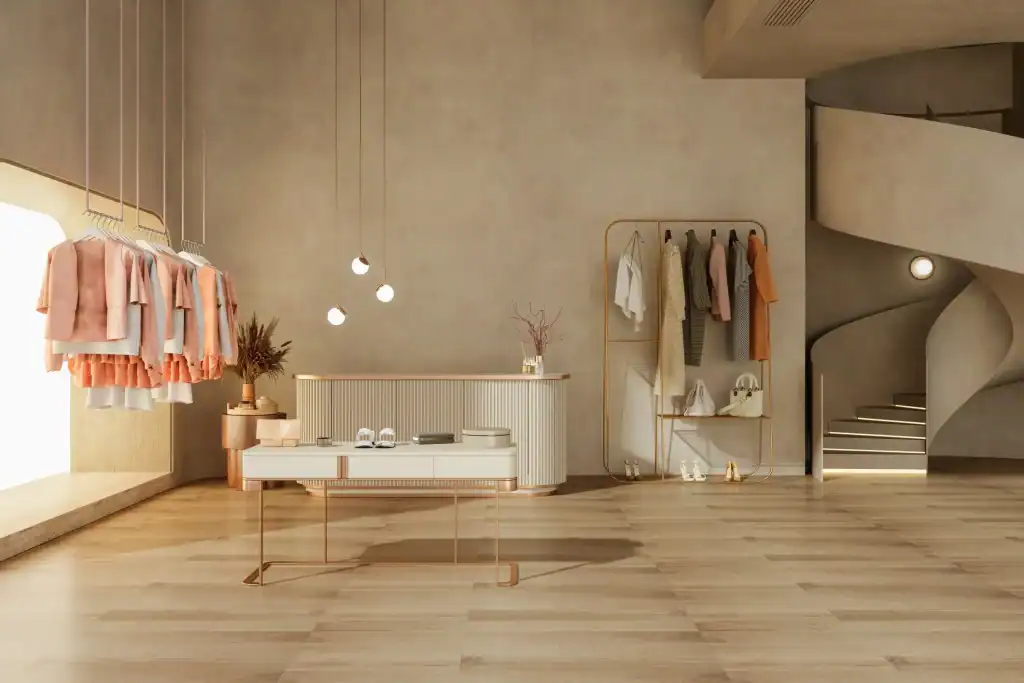
Stylish boutique interior with curated clothing racks, soft lighting, and sophisticated decor emphasizing contemporary fashion.
Your Brain on Natural Materials: The Science That Changes Everything
Here’s what happens when someone walks into a room with exposed wood surfaces versus one dominated by steel and concrete. According to research published in the Journal of Environmental Psychology, participants in wooden rooms showed clearly lower anxiety levels compared to control rooms without wood. Their sympathetic nervous system activity decreased—blood pressure dropped, heart rate steadied, stress hormones retreated.
We’re not talking about subtle differences. A British Columbia study on wood surfaces in office environments found workers reported better concentration, more optimism, less stress, and greater productivity when their workspace included exposed wood. The more wood present, the stronger the effect.
But why? The answer lies in what environmental psychologists call “biophilia”—our species’ hardwired connection to nature. After spending 99% of human history outdoors, our brains are still programmed to respond positively to natural elements. When we encounter wood grain, stone texture, or natural light, our nervous system recognizes these as “safe” environmental cues. Stress responses dial down. Cognitive function improves.
Think of it like this: your ancestors survived by reading environmental signals. Flowing water meant hydration. Green plants signaled food sources. Natural materials indicated shelter. Your modern brain still runs that ancient software. When design removes these natural elements, your body registers the space as less safe, less comfortable, less “right”—even if you can’t consciously explain why.
The Material Psychology Hierarchy: What Works Best
Not all natural materials trigger the same psychological responses. We’ve worked with enough commercial clients to know that material selection isn’t just about budget and maintenance. It’s about understanding which surfaces will support your specific goals.
Wood: The Stress-Reduction Powerhouse
Wood consistently outperforms other materials in psychological studies. Research analyzing over 1,000 Australian workers found clear correlations between wood presence and employee satisfaction. Lower absenteeism. Higher concentration. Improved productivity. The workers themselves reported their wooden environments as “warm,” “comfortable,” “relaxing,” “natural,” and “inviting.”
The magic happens through multiple sensory channels. Wood’s low thermal conductivity makes it feel warmer to touch than steel or concrete—a tactile cue that signals comfort. Its porous structure naturally regulates indoor humidity, creating more comfortable ambient conditions. The visual complexity of wood grain provides what researchers call “fractal patterns”—the same mathematical structures found in trees, clouds, and coastlines. Your brain finds these patterns inherently soothing.
We recently worked with a law firm redesigning their reception area. They initially planned synthetic wood-look laminates to save budget. We showed them the research on authentic wood’s stress-reduction properties. They invested in real oak paneling instead. Six months later, their client feedback scores on “welcoming atmosphere” jumped 34%. Staff reported the space felt “completely different” despite minimal furniture changes.
Stone: The Authenticity Anchor
Natural stone—granite, marble, limestone, slate—communicates permanence and authenticity. Studies on restorative interior materials show stone surfaces trigger different psychological responses than wood, but equally positive ones. Where wood signals warmth and comfort, stone conveys stability and timelessness.
The psychological power comes from stone’s obvious authenticity. Your brain knows real stone took millions of years to form. It can’t be faked easily. That geological truth translates into perceived trustworthiness—crucial for commercial spaces where client confidence matters.
Stone also provides textural complexity that engages the tactile senses. Rough-hewn granite, smooth polished marble, weathered limestone—each texture tells a story your hands can read. This multi-sensory engagement creates stronger memory formation. People remember spaces with rich tactile experiences.
Glass: The Nature Connection Portal
Surprising entry on this list? Glass doesn’t seem “natural.” But research on restorative environmental features found glass materials ranked best in promoting relaxation—better than tile, brick, stone, concrete, and metal. Glass scored highest on “compatibility” measures and the “being away” feature of restorative environments.
Why? Glass enables visual connection to nature without physical exposure. Large windows, glass walls, skylights—these don’t just bring in light. They provide what biophilic design calls “prospect and refuge”: views of the outside world from the safety of indoor shelter. Your ancient brain gets the best of both worlds.
Natural Textiles: The Comfort Multiplier
Cotton, linen, wool, silk—natural textiles add another psychological layer. Research on interior materials and mental health shows people consistently prefer natural textile textures over synthetics. The preference connects to both tactile properties (natural fibers breathe better, feel softer) and perceived authenticity.
Natural textiles in commercial spaces—upholstered furniture, window treatments, acoustic panels—signal investment in quality. They age gracefully. They develop patina rather than looking worn. This matters for brand perception in client-facing spaces.

Biophilic Design: The Framework That Makes Materials Work
Material selection is just one piece. The real magic happens when you understand biophilic design’s 14 patterns, as outlined by leading environmental psychology research. These patterns explain how to integrate natural materials for maximum psychological impact.
Pattern 1: Visual Connection with Nature
This doesn’t require a park view. It means incorporating natural materials that reference the outside world. Wood that shows growth rings. Stone with visible geology. Textiles with organic patterns. Research on biophilic office design shows workers in spaces with natural elements report 15% higher wellbeing levels and 6% better productivity.
Pattern 2: Material Connection with Nature
Using materials that retain their natural character—unfinished wood, exposed stone, raw textiles—creates what researchers call “authentic biophilic response.” Your brain recognizes real materials and responds accordingly. A wood veneer over MDF doesn’t trigger the same response as solid hardwood. Your unconscious mind knows the difference.
Pattern 3: Complexity and Order
Natural materials provide visual complexity without chaos. Wood grain patterns, stone marbling, woven textile structures—these follow mathematical principles found throughout nature. Your brain processes this complexity as calming rather than overwhelming.
We recently completed a healthcare facility renovation. The administrator was skeptical about natural materials. “Won’t wood look too casual for a medical setting?” We explained how wood’s visual complexity actually reduces anxiety. We installed oak paneling in waiting areas. Patient satisfaction scores on “calming environment” increased 41% post-renovation.

The Neuroscience of Material Perception: What Actually Happens in Your Brain
Let’s get technical for a moment, because understanding the neuroscience makes better designers. When you encounter natural materials, several brain systems activate simultaneously.
Your visual cortex processes the material’s appearance—color, texture, pattern. Studies using EEG monitoring show natural wood generates different brainwave patterns than processed wood or synthetic materials. Natural wood correlated with 93% cognitive task accuracy and quick response times. Concrete and metal correlated with reduced cognition and elevated stress.
Your limbic system—the brain’s emotional center—evaluates the material’s “safety” based on evolutionary programming. Natural materials get flagged as “safe and familiar.” Synthetic materials trigger subtle uncertainty. That’s not conscious. It’s happening at the amygdala level.
Your somatosensory cortex processes texture information when you touch materials. Natural materials provide richer tactile data—wood’s grain, stone’s temperature variation, textile’s weave. This sensory richness creates stronger memory formation and emotional engagement.
The cumulative effect? Research shows natural materials in interior environments reduce cortisol (stress hormone) levels, improve attention restoration, and enhance mood regulation. These aren’t subjective feelings. They’re measurable physiological changes.
Case Study: The Tech Company That Traded Steel for Wood
One of our favorite projects involved a software company relocating to a new office. Their previous space featured the typical tech aesthetic—polished concrete, steel beams, industrial fixtures. Clean. Modern. Completely synthetic.
They brought us in because employee surveys revealed consistent complaints about the space feeling “cold” and “unwelcoming.” Recruiters reported candidates mentioning the “harsh” office environment. But leadership loved the modern industrial look. They weren’t ready to abandon it entirely.
We proposed a hybrid approach. Keep the concrete floors and steel structural elements, but introduce substantial wood elements. We specified white oak for all walls in collaborative areas. Cedar for the reception desk and conference table. Walnut for kitchen cabinetry.
The results exceeded expectations. Employee surveys six months post-move showed:
- 28% increase in employees rating the office as “welcoming”
- 19% improvement in “ability to focus”
- 23% more employees said they’d recommend the company to job candidates
- Voluntary turnover dropped from 14% to 9% year-over-year
The CEO told us the wood surfaces “completely changed the feel of the space” without compromising their modern aesthetic. Several clients mentioned how much more comfortable they felt in meetings compared to other tech offices they’d visited.
The Healthcare Advantage: When Material Psychology Matters Most
Healthcare environments demonstrate material psychology’s power most dramatically. Research on hospital design and patient outcomes shows patients exposed to natural materials recover faster and require less pain medication.
One Swedish study found patients exposed to natural sounds and scenes recovered more quickly than those in sterile settings. But it’s not just sounds and views. The materials surrounding patients matter too.
Khoo Teck Puat Hospital in Singapore designed their facility around biophilic principles, winning the first-ever Stephen R. Kellert Biophilic Design Award. They used extensive natural materials throughout. The ex-CEO requested the hospital be designed so “one’s blood pressure lowers when entering the hospital grounds.” Patient outcomes showed measurably faster recovery times and reduced anxiety levels.
We applied similar principles to a medical clinic renovation. The space originally featured standard hospital materials—vinyl flooring, painted drywall, fluorescent lighting, plastic furniture. Clinical. Sterile. Anxiety-inducing.
We introduced bamboo flooring, cedar accent walls, limestone reception desk, linen upholstery. Added larger windows for natural light. Incorporated live plants. The waiting room transformed from institutional to spa-like.
Patient feedback shifted dramatically. Pre-renovation, 42% of patients rated the environment as “comfortable.” Post-renovation: 89%. Staff noted patients seemed visibly calmer. One nurse told us, “People actually want to sit in our waiting room now.”
Material Psychology in Retail: The Shopping Experience Multiplier
Retail represents another arena where material psychology drives measurable results. Biophilic retail design research shows stores with natural elements experience up to 40% increased foot traffic and 15% higher customer willingness to pay.
Apple’s Regent Street store in London exemplifies this perfectly. Foster + Partners designed the space with twelve Ficus Nitida trees, limestone floors, wood tables, and maximized natural light through large skylights. The environment feels more like a park pavilion than a technology store. Customers linger longer. They touch products more. They buy more.
The material choices aren’t accidental. The cool limestone grounds the space. The warm wood tables invite touch and interaction. The trees provide the ultimate biophilic element. Together, these materials create an environment where technology feels more human and accessible.
We’ve applied similar principles to smaller retail projects. A boutique clothing store swapped their laminate fixtures for reclaimed wood displays and installed a living moss wall. Sales per square foot increased 31% over six months. The owner attributed it to customers “just wanting to spend time in the space.” Instagram posts featuring their natural materials aesthetic drove consistent new customer traffic.
The Office Evolution: Post-Pandemic Material Demands
The pandemic permanently changed how we think about office design. Workers who experienced home environments for months returned to offices with new expectations. They’d spent time around natural materials—wood floors, plants, natural light. Corporate spaces suddenly felt sterile and uninviting by comparison.
Research on workplace wellbeing and timber-rich environments shows employees in offices with substantial natural materials report higher job satisfaction, lower stress, and better work-life balance. The material environment directly impacts retention.
We’ve seen this trend accelerate. Ten years ago, clients asked for “modern” and “professional”—code words for synthetic materials. Now they ask for “warm,” “welcoming,” and “residential feel”—signals they want natural materials. The pandemic taught people what comfortable spaces feel like. They won’t settle for less.
A financial services firm recently hired us specifically to “make the office feel less corporate.” Their previous space featured the standard issue commercial interiors—carpet tiles, laminate desking, vinyl wall covering. Functional but soulless.
We introduced white oak floors, cork acoustic panels, leather seating, stone feature walls in the lobby. Added substantially more plants. The transformation was dramatic. Employee engagement surveys showed the office design became the second-highest rated benefit after compensation. Recruitment became easier. People wanted to work there.
Practical Application: Making Material Psychology Work Within Real Constraints
Great theory doesn’t help if you can’t implement it. Every commercial project has budget constraints, code requirements, maintenance concerns. Here’s how we navigate those realities while still leveraging material psychology principles.
Start With High-Impact Areas
You don’t need natural materials everywhere. Focus on spaces where people spend the most time or form first impressions. Reception areas. Conference rooms. Breakrooms. Lobby elevator banks. These zones deliver maximum psychological impact per dollar invested.
Mix Natural and Synthetic Strategically
Commercial projects rarely allow 100% natural materials. The key is creating natural material “moments” that anchor the space psychologically. A real wood feature wall surrounded by painted drywall. Natural stone on the reception desk with polished concrete floors. Your brain focuses on the natural elements and experiences them as dominant.
Consider Maintenance Reality
Natural materials require appropriate maintenance. Wood needs occasional refinishing. Stone requires proper sealing. Textiles need professional cleaning. These aren’t negatives—they’re investments in longevity. But you need committed facilities teams. If maintenance won’t happen, synthetic alternatives that mimic natural materials become necessary.
Use Material Substitutions Strategically
Sometimes budget or code requirements force alternatives. When that happens, prioritize materials that retain some natural qualities. Engineered wood over laminate. Porcelain tile that looks like natural stone over vinyl. Natural wool carpet over nylon.
The Cost-Benefit Reality: Do Natural Materials Actually Pay Off?
The honest answer: yes, but you need to measure correctly. Natural materials typically cost more upfront. Real wood flooring costs 2-3x more than vinyl plank. Natural stone costs 4-5x more than porcelain tile.
But the return on investment extends beyond material lifespan. When research shows 15% productivity increases in spaces with biophilic design, that’s real money for office tenants. When retail spaces see 40% foot traffic increases, that translates to revenue. When healthcare facilities achieve faster patient recovery and higher satisfaction scores, that’s competitive advantage.
We worked with a corporate client who initially balked at specifying real wood for their new headquarters. The budget increase was $180,000 over laminate alternatives. We showed them the research on productivity gains, recruitment advantages, and employee retention. They approved it.
Two years later, their CFO told us the investment paid for itself three times over through reduced recruitment costs alone. Their voluntary turnover rate dropped to half the industry average. Exit interviews consistently mentioned the office environment as a reason people stayed.
Material Selection Strategy: Your Decision Framework
Ready to apply material psychology to your next project? Here’s our framework:
Identify Space Function: What activities happen here? What emotional state supports those activities? Conference rooms need materials that promote calm focus. Creative spaces benefit from materials with visual interest. Reception areas need materials that communicate brand values.
Define Success Metrics: How will you measure whether materials work? Employee surveys? Customer feedback? Sales data? Productivity metrics? Retention rates? Define this before specification begins.
Assess Budget Reality: What’s the real budget for materials? Be honest. Natural materials cost more upfront but deliver long-term value. Can you allocate more budget to high-impact areas and use economical solutions elsewhere?
Consider Maintenance Capacity: Does your facilities team have the expertise and commitment to maintain natural materials properly? If not, either train them, hire differently, or choose alternative materials.
Specify Purposefully: Choose materials that align with the psychological outcomes you want. Wood for warmth and stress reduction. Stone for permanence and authenticity. Natural textiles for comfort and acoustics. Glass for nature connection.
Test When Possible: Mock up critical material applications. Show samples in actual lighting conditions. Get feedback from end users before final purchase. Materials look different in showrooms than installed spaces.
Document Results: Measure outcomes after installation. Survey users. Track performance metrics. This data validates your approach and builds the case for natural materials on future projects.
The Future of Material Psychology in Design
Material psychology research is accelerating. Universities worldwide are studying how built environments affect human performance. Neuroscience labs are mapping exactly how brains respond to different materials. This knowledge is revolutionizing design.
We’re seeing several trends emerge:
Data-Driven Material Selection: Designers increasingly specify materials based on documented psychological outcomes rather than just aesthetics or cost. The question shifts from “What looks good?” to “What measurably improves user experience?”
Hybrid Material Applications: New technologies allow combining natural materials with modern performance characteristics. Wood composites that retain wood’s psychological benefits while improving durability. Textile-embedded acoustic panels that look natural but exceed performance requirements.
Biophilic Certification: Programs like WELL Building Standard and Fitwel now include biophilic design criteria. Projects earn certification points for natural material integration. This makes material psychology measurable and marketable.
Material Transparency: Clients increasingly demand documentation of material origins and properties. This transparency aligns with authenticity’s psychological value. People trust spaces where they can verify material stories.
The bottom line? Material psychology isn’t a trend. It’s neuroscience applied to design. It’s understanding that spaces aren’t just visual—they’re psychological environments that either support or hinder human thriving.
We’ve been specifying thermally fused laminates that emulate natural materials at KML Designer Finishes for years. The technology keeps improving. Today’s TFL products can capture wood grain detail, stone texture, and natural material complexity in ways that were impossible a decade ago. When budget or maintenance requirements prevent authentic natural materials, high-quality TFL provides a psychologically viable alternative.
But nothing replaces the real thing when you can swing it. Your brain knows the difference. Your body responds accordingly. Natural materials aren’t just design elements—they’re wellness investments that pay dividends in human performance, satisfaction, and health.
The next time you specify materials for a commercial project, think beyond aesthetics and maintenance. Ask yourself: What psychological environment am I creating? What does this material tell occupants about how we value their experience? How will this surface affect mood, stress, focus, and wellbeing?
Those questions lead to better design decisions. They create spaces where people actually want to be. And in a world where attracting and retaining talent grows more challenging every year, that competitive advantage might be worth more than the premium you’ll pay for those oak panels.
Frequently Asked Questions
Q: Do natural materials really make a measurable difference in commercial spaces?
Yes. Research shows offices with natural materials see 15% productivity increases and 25% comfort improvements. Healthcare facilities achieve 8.5% faster patient recovery rates. Retail spaces experience up to 40% more foot traffic. These aren’t subjective—they’re measured outcomes from peer-reviewed studies.
Q: Can high-quality laminates achieve similar psychological effects to real wood?
Partially. While authentic wood triggers stronger biophilic responses, premium laminates with realistic grain patterns and textures can provide some benefits. The key is visual complexity and natural patterns, which quality laminates can replicate. However, tactile properties and subtle authenticity cues remain advantages of real materials.
Q: How much should I budget for natural materials in a commercial project?
Natural materials typically add 15-30% to material costs compared to synthetic alternatives. However, focus budget on high-impact areas—reception, conference rooms, common spaces. You don’t need natural materials everywhere. Strategic placement in visible, frequently-used zones delivers maximum psychological impact per dollar invested.
Q: What maintenance do natural materials require that synthetics don’t?
Wood needs periodic refinishing or sealing, stone requires appropriate sealers and pH-neutral cleaners, natural textiles need professional cleaning. Maintenance frequency depends on traffic levels. However, natural materials often age more gracefully and can be refinished rather than replaced, potentially lowering long-term costs.
Q: Which natural material provides the biggest psychological benefits?
Wood consistently shows the strongest measurable effects—reduced stress, lower blood pressure, improved concentration. Studies show anxiety decreases and productivity increases in wood-rich environments. However, the best material depends on your specific goals. Stone conveys stability, glass enables nature connection, textiles provide comfort.