
Biophilic Design Elements: 7 Natural Features That Go Way Beyond Potted Plants
| green building , Commercial Design , Sustainable Materials

When most people hear “biophilic design,” they picture a living wall hogging the lobby—but the real magic happens in the stone grain running across a reception desk, the dappled light filtering through a partition, and the curved corridor that makes your brain whisper forest path. We’ve spent years watching commercial interiors transform through biophilic principles, and here’s what we’ve learned: the fern is just the beginning.
In this article, you’ll learn:
- Why biophilic design encompasses far more than greenery and daylight
- How fractal patterns, organic shapes, and natural materials reduce occupant stress
- Which biophilic materials—including stone-look TFL laminates—deliver nature’s aesthetic without the maintenance headaches
- How spatial configurations like prospect and refuge affect how people feel in your spaces
- Practical strategies for layering biophilic elements across healthcare, corporate, and hospitality projects
- Measurable ROI data you can share with skeptical clients
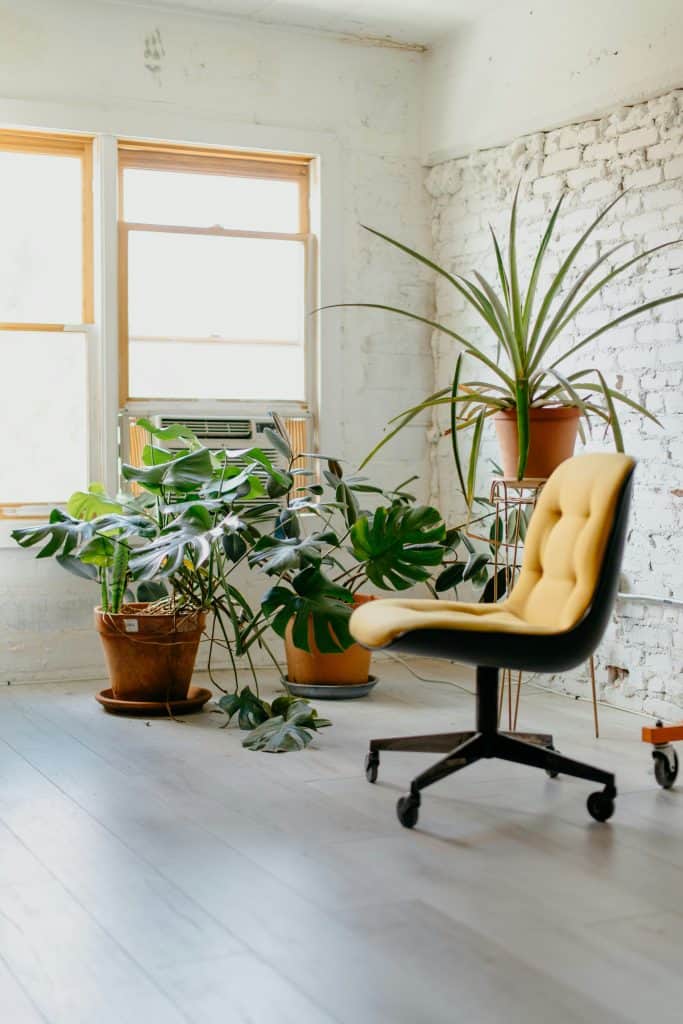
What Biophilic Design Actually Means (And Why the Definition Matters)
The Science Behind Our Nature Craving
Biophilia isn’t a design trend. It’s a biological reality. Harvard biologist E.O. Wilson popularized the biophilia hypothesis in the 1980s, proposing that humans possess an innate emotional affiliation with other living organisms and natural systems. We evolved surrounded by trees, water, stone, and sky. Our nervous systems still respond to those elements—even when they appear as patterns on a laminate surface or curves in a ceiling detail.
Research confirms what our instincts already know. A systematic review published in Taylor & Francis found that biophilic design yields significant psychological, physiological, and cognitive benefits in workplace settings. Workers in environments with natural elements report 6% higher productivity and 15% greater creativity compared to those in sterile spaces. These aren’t marginal gains. For a 500-person office, that creativity boost alone could justify an entire interior renovation.
Direct vs. Indirect vs. Space-and-Place Biophilia—A Quick Framework
Biophilic design breaks into three categories, and understanding them helps you spec smarter:
- Direct biophilia includes literal nature: plants, water features, natural light, and views of the outdoors
- Indirect biophilia uses natural analogues—materials, patterns, colors, and textures that evoke nature without requiring irrigation or sunlight
- Space-and-place biophilia addresses spatial configurations that trigger evolved preferences, like the desire for both open views and sheltered corners
Most designers focus exclusively on direct biophilia. That’s a missed opportunity. Indirect and spatial approaches often cost less, require zero maintenance, and work in windowless spaces where plants would struggle to survive.
The Usual Suspects—And Their Limitations
Living Walls and Potted Plants: Maintenance Realities
We love a good green wall. Nothing photographs better for your portfolio. But let’s be honest about what happens after the installation team leaves. Living walls require irrigation systems, specialized lighting, regular pruning, pest management, and replacement plants when specimens fail. We’ve seen gorgeous vertical gardens turn into patchy eyesores within eighteen months because clients underestimated the maintenance commitment.
Potted plants face similar challenges. That fiddle-leaf fig looks spectacular in the rendering. In reality, it needs consistent watering, appropriate light levels, and protection from HVAC drafts. Office managers already juggling a hundred responsibilities rarely have bandwidth for plant parenthood.
Windows and Daylight: When Architecture Won’t Cooperate
Natural light remains one of the most powerful biophilic interventions. But many commercial spaces lack adequate fenestration. Interior zones, basement levels, and retrofit projects often have minimal or zero window access. You can’t redesign the building envelope for every project. You need biophilic strategies that work regardless of what the architect handed you.
Biophilic Materials—Nature You Can Spec
Here’s where biophilic design gets interesting for commercial specifiers. Natural materials and their analogues deliver biophilic benefits without the maintenance burden of living elements.
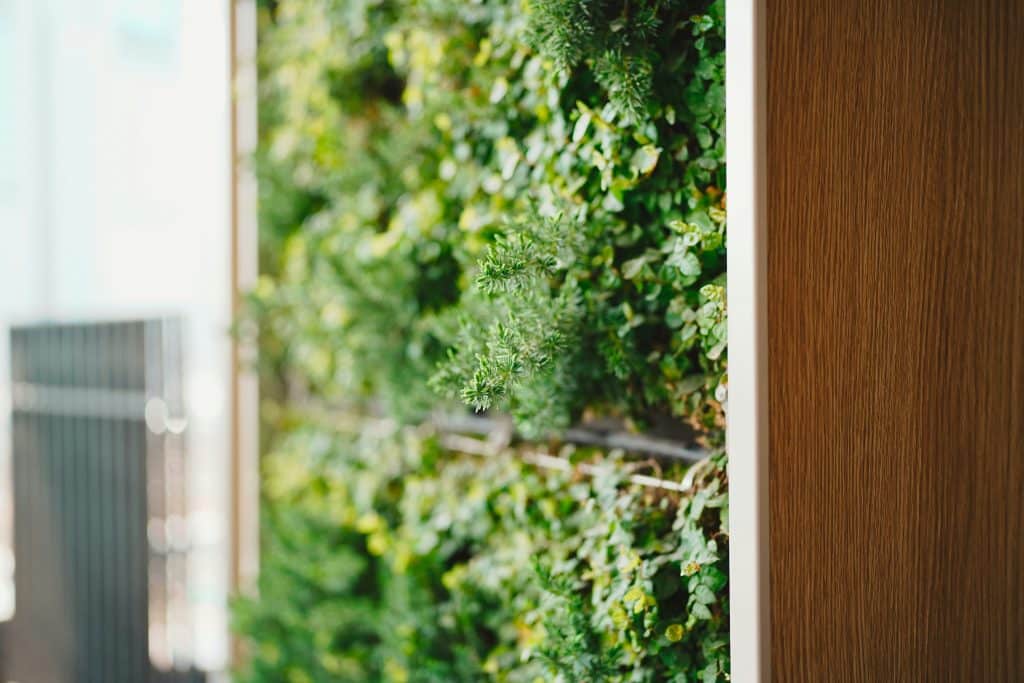
Wood Grains, Stone Looks, and Organic Textures in Laminates
Research from The Design Sheppard indicates that interior spaces with a wood ratio of approximately 45% on walls boost perceived comfort and lower blood pressure. The key insight? Our visual systems respond to the appearance of natural materials. The grain patterns, color variations, and textural irregularities trigger positive responses whether the surface is solid timber or a high-quality laminate.
Stone surfaces work similarly. The veining in marble, the mineral deposits in granite, the striated layers in slate—these patterns evolved over geological time, and our brains recognize their complexity as fundamentally different from manufactured uniformity. We’re drawn to natural stone’s cool thermal properties, its visual weight, and its connection to earth.
Why Stone-Look TFL Delivers Biophilic Impact Without the Weight
This is where we get excited about thermally fused laminate. Stone-look TFL from manufacturers like KML Designer Finishes captures the visual complexity of natural stone while solving practical problems that plague actual quarried material.
Real stone is heavy. It requires structural reinforcement, specialized installation, and careful sealing. It’s expensive to ship, difficult to cut on site, and unforgiving of mistakes. Stone-look TFL weighs a fraction as much, cuts cleanly with standard tools, and arrives ready to install. You get the biophilic visual impact—the veining, the mineral variation, the perceived connection to geological processes—without the logistical headaches.
For healthcare environments where infection control matters, TFL’s non-porous surface outperforms natural stone’s microscopic crevices. For hospitality projects on tight timelines, TFL’s installation speed beats stone by days. For corporate clients watching budgets, TFL delivers the aesthetic at a fraction of the material cost.
Natural Fibers, Cork, and Reclaimed Elements
Beyond wood and stone analogues, consider other biophilic materials that add textural variety. Cork provides warmth, acoustic absorption, and a distinctive cellular pattern that reads as organic. Wool textiles invite touch. Linen softens acoustically harsh spaces. Reclaimed wood brings historical character alongside sustainability credentials.
The principle remains consistent: select materials that show their natural origin through visual texture, color variation, and tactile interest.
Patterns and Shapes Borrowed From the Outdoors
Fractal Geometry: The Math Behind “That Feels Right”
Fractals are patterns that repeat at different scales—think tree branches, river deltas, mountain ridges, or cloud formations. These self-similar structures appear constantly in nature, and research confirms our brains are specifically tuned to process them.
A comprehensive review in MDPI Sustainability explains the “fractal fluency” model: human vision evolved to process mid-range fractals with ease, generating both aesthetic pleasure and physiological stress reduction. Studies using skin conductance and heart rate measurements found that exposure to mid-range fractals (complexity levels of 1.3-1.5) measurably reduced stress during recovery.
What does this mean for your projects? Incorporate fractal patterns through ceiling details, floor treatments, wall panels, and decorative screens. The patterns don’t need to be obvious. Subtle branching motifs, irregular geometric progressions, and organic tessellations all trigger fractal fluency.

A collection of decorative ceramic tiles with vivid, detailed patterns perfect for enhancing home or commercial space aesthetics, featuring traditional Mediterranean and Spanish tile designs.
Organic Curves vs. Rigid Grids
Nature rarely produces right angles. Rivers meander. Coastlines undulate. Trees grow in graceful arcs. When commercial interiors default to rigid grids and sharp corners, they create environments that feel institutional rather than nurturing.
Introduce organic curves through furniture selection, millwork details, and spatial planning. Curved reception desks, arched doorways, and rounded seating arrangements soften visual character while maintaining professional sophistication.
Biomimicry in Furniture and Fixtures
Biomimicry extends biophilic thinking to product design. Furniture that references natural structures—chairs with leaf-like backs, lighting with branching arms, tables with organic edge profiles—reinforces nature connection throughout a space. These choices layer with material selections to create immersive biophilic environments.
Light, Shadow, and Movement—Dynamic Natural Features
Circadian-Friendly Lighting Strategies
Natural daylight varies throughout the day, shifting from cool morning tones to warm afternoon hues. Our circadian rhythms evolved around these variations. Static artificial lighting ignores that biological reality.
Tunable LED systems now allow designers to program lighting that mimics daylight’s daily progression. Morning settings emphasize cooler, more activating wavelengths. Afternoon settings shift warmer. This circadian alignment improves sleep quality, alertness, and overall wellbeing for building occupants.
Dappled Light Effects and Variable Luminance
Forest canopies create dappled light—areas of brightness interspersed with shadow that shift as leaves move in the breeze. This dynamic light quality engages our attention without demanding focus. It’s restorative rather than fatiguing.
Recreate dappled effects through perforated screens, decorative metal panels, or laser-cut partitions that allow light to filter through irregular openings. The resulting light patterns move throughout the day, creating living shadow compositions.
Water Features and Reflective Surfaces
Water adds movement, sound, and reflected light to interior environments. Even small-scale water features—tabletop fountains, wall-mounted cascades, or lobby reflecting pools—introduce dynamic elements that static surfaces cannot provide. Where water isn’t practical, polished surfaces and strategic mirror placement can capture and multiply available light, creating comparable visual animation.
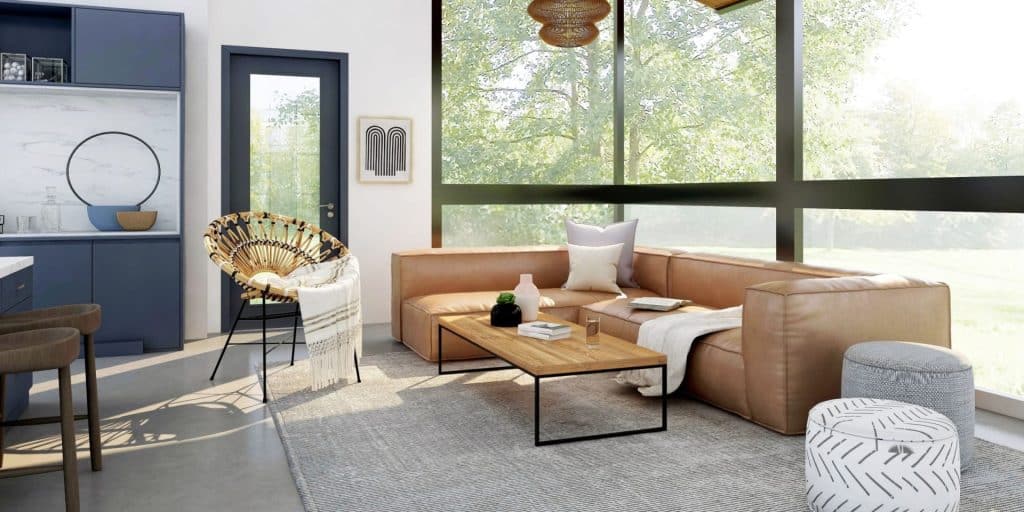
A bright and inviting modern living room featuring a sleek leather sectional sofa, large panoramic windows, minimalistic coffee table, and stylish decor elements for contemporary interior design.
Sensory Layers Beyond Sight
Acoustic Biophilia: Natural Soundscapes and Material Absorption
Sound matters more than many designers acknowledge. Harsh reverberation in large commercial spaces creates stress and fatigue. Natural environments, by contrast, feature sound-absorbing elements—soil, foliage, water—that create softer acoustic profiles.
Integrate acoustic panels with organic textures. Specify sound-absorbing ceiling treatments. Consider background soundscapes featuring gentle water sounds, birdsong, or wind through leaves. Research published in ScienceDirect confirms that multisensory biophilic interventions—combining visual and auditory elements—produce stronger stress reduction than visual interventions alone.
Tactile Variety: Textured Surfaces That Invite Touch
Most commercial interiors discourage touching. Everything is smooth, uniform, and impersonal. Natural environments invite tactile exploration—rough bark, smooth stones, soft moss, textured leaves.
Introduce tactile variety through material selections that reward touch. Textured laminates, fabric-wrapped panels, rough stone accents, and natural-fiber upholstery create opportunities for tactile engagement that reconnect occupants with physical reality.
Scent and Airflow Considerations
Natural environments smell alive. Commercial interiors often smell like cleaning chemicals or recirculated air. Where possible, improve ventilation with fresh air intake. Consider essential oil diffusers using cedar, pine, or eucalyptus scents that evoke natural settings. Even subtle olfactory cues reinforce biophilic character.
Spatial Configurations That Echo Nature
Prospect and Refuge: Balancing Openness and Shelter
British geographer Jay Appleton introduced prospect-refuge theory in 1975, arguing that humans instinctively prefer environments offering both open views (prospect) and protected niches (refuge). We evolved scanning savannas for opportunities while seeking shelter from threats.
Modern spaces that provide prospect without refuge—think open-plan offices with no visual boundaries—leave occupants feeling exposed. Spaces offering refuge without prospect—think windowless private offices—feel claustrophobic. The sweet spot combines both: seating with back protection that overlooks larger spaces, elevated perches with views, alcoves that shelter while maintaining sightlines.
According to Terrapin Bright Green’s influential “14 Patterns of Biophilic Design”, rooms with generous prospects decrease perceived vulnerability and improve comfort, while refuge spaces provide necessary withdrawal from environmental stimulation.
Wayfinding Through Organic Pathways
Straight corridors feel institutional. Meandering paths feel exploratory. Where possible, introduce subtle curves into circulation routes. Create visual interest through glimpses of what lies ahead. Use changes in ceiling height, lighting intensity, and material character to define transitions between zones.
Transition Zones That Mimic Outdoor Thresholds
Natural environments feature gradual transitions: forest edges blend into meadows, shorelines transition from sand to water. Commercial interiors often create abrupt boundaries—lobby to corridor, corridor to workspace.
Design transition zones that buffer between different space types. Entry sequences that progress from active to calm help occupants mentally shift modes. Material palettes that evolve across transitions reinforce spatial hierarchy.
Sector Snapshots—Biophilic Elements in Action
Healthcare: Stress Reduction and Recovery Metrics
Healthcare environments generate significant stress for patients, families, and staff. Biophilic interventions show measurable impact. A 2024 systematic review in Frontiers of the Built Environment found that biophilic design in hospitals reduces hospitalization time, patient mortality, pain levels, and stress for healthcare providers. It also alleviates anxiety and supports faster recovery.
The landmark 1984 study by Roger Ulrich compared surgical patients with nature views to those viewing brick walls. Patients seeing trees required less pain medication and left the hospital sooner. This research established evidence-based design as a healthcare discipline.
Corporate Workplace: Productivity and Retention Data
The business case for biophilic workplace design is clear. Beyond the 6% productivity and 15% creativity gains mentioned earlier, biophilic offices show improved employee retention. Given that replacing a single employee can cost 50-200% of annual salary, reduced turnover alone justifies biophilic investments.
We’ve seen corporate clients initially skeptical of “wellness design” become enthusiastic advocates once they track post-occupancy metrics. Absenteeism decreases. Engagement survey scores improve. Recruiting becomes easier when candidates tour attractive spaces.
Hospitality and Retail: Guest Experience and Dwell Time
Hospitality environments compete on experience. Biophilic design creates memorable, photograph-worthy spaces that generate social media exposure and positive reviews. Retail environments using biophilic principles show increased dwell time—shoppers stay longer in spaces that feel comfortable and engaging.
Specifying Biophilic Elements—Practical How-To
Layering Multiple Elements for Maximum Effect
Single biophilic gestures—one green wall, one water feature—create momentary interest but don’t transform environments. Effective biophilic design layers multiple elements across all senses: visual materials, tactile textures, acoustic treatments, lighting quality, and spatial configuration working together.
Build a biophilic checklist for each project: direct nature elements, indirect analogues, spatial patterns, sensory variety. Score your design against each category. Aim for coverage across all dimensions rather than intensity in one.
Budget-Conscious Material Swaps
Tight budgets don’t preclude biophilic design. Swap expensive natural stone for stone-look TFL that captures visual complexity at lower cost. Use wood-grain laminates instead of solid timber on large surfaces. Specify acoustic panels with organic textures rather than premium natural fibers. Strategic substitutions deliver biophilic impact while protecting project economics.
Coordinating With Wellness Certifications (WELL, Fitwel, LEED)
Biophilic design elements contribute to wellness certification credits. WELL Building Standard includes biophilia requirements. Fitwel rewards nature access and quality views. LEED credits sustainable materials that often overlap with biophilic selections.
Document biophilic elements carefully during design development. Photograph installations thoroughly. Maintain product specifications that demonstrate compliance. Certification programs increasingly recognize biophilia’s value, creating client-facing validation for your design decisions.
Measuring Success—KPIs and Post-Occupancy Indicators
Occupant Surveys and Biometric Feedback
Post-occupancy evaluation should include biophilia-specific questions: Do occupants feel connected to nature? Do spaces feel calm or stressful? Would they recommend the environment to others?
Advanced clients are beginning to track biometric indicators—heart rate variability, skin conductance, even EEG measurements—to quantify stress responses in different building zones. While still emerging, these tools will increasingly validate biophilic investments with hard data.
Absenteeism, Productivity, and Lease Renewal Trends
Track operational metrics before and after biophilic interventions. Absenteeism rates, employee engagement scores, productivity measurements, and lease renewal decisions all reflect environmental quality. Building the business case for future projects requires collecting this evidence systematically.
FAQs
What’s the difference between biophilic design and sustainable design? Sustainable design minimizes environmental impact. Biophilic design maximizes human connection to nature. They overlap but aren’t identical—a LEED-certified building might lack biophilic character, while a biophilic space might use materials with complex sustainability profiles.
Can biophilic design work in windowless spaces? Absolutely. Indirect biophilia through materials, patterns, and spatial configuration works independent of daylight. Stone-look surfaces, wood-grain laminates, fractal patterns, and organic curves all deliver biophilic benefits in interior zones.
How much does biophilic design add to project costs? Costs vary widely. Living walls and water features require significant investment. Material swaps—choosing stone-look TFL instead of plastic laminate—may add minimal cost while delivering substantial biophilic impact.
Which biophilic elements offer the best ROI? Daylight optimization (where possible), natural material finishes, and spatial configurations typically offer strong returns because they require no ongoing maintenance while providing continuous benefits.
Do biophilic principles apply to temporary or pop-up installations? Yes. Portable plants, fabric panels with organic patterns, and reconfigurable furniture with natural materials can bring biophilic qualities to temporary spaces.