Stop Following 2025 Color Trends (Do This Instead for Timeless Spaces)

Chasing 2025 color trends is like buying a new wardrobe every season—expensive, exhausting, and guaranteed to look dated by next year’s forecast. Paint companies roll out their “color of the year” announcements like clockwork, design blogs breathlessly declare “what’s in” and “what’s out,” and suddenly your perfectly functional palette feels stale. But here’s the truth commercial designers already know: the spaces that endure aren’t the ones that chase trends. They’re the ones built on strategy, psychology, and materials that reward patience instead of panic.
If you’re specifying interiors meant to last seven, ten, or fifteen years, betting your budget on a trending hue is a gamble you’ll lose. This guide flips the script. You’ll discover why annual color forecasts sabotage long-term value, four timeless strategies that outlast every trend cycle, and how to leverage durable materials like Thermally Fused Laminate (TFL) to anchor color decisions that age like fine wine instead of sour milk.
Article Main Points
- Why annual color trends sabotage long-term design value
- Four timeless color strategies that outlast every forecast
- How psychology and brand alignment trump trendy palettes
- Why material choice (like TFL) anchors color permanence
- Practical steps to audit and future-proof your palette

Why 2025 Color Trends Will Fail Your Next Project
The Built-in Obsolescence of Annual Palettes
Paint manufacturers aren’t in the longevity business—they’re in the refresh business. Benjamin Moore’s 2025 pick, Cinnamon Slate, is a lovely heathered plum-brown. But it follows a parade of previous winners that each had their moment before fading into the archives. Sherwin-Williams, Behr, and PPG operate on the same cycle: announce a bold new direction, generate buzz, sell paint, repeat.
The problem? Your commercial project timeline doesn’t sync with their marketing calendar. The average office refresh happens every seven to ten years. Healthcare and education facilities push even longer. Meanwhile, a trending color’s cultural relevance lasts twelve to eighteen months—maybe two years if it’s lucky. Specify today’s “it” shade on durable casework or flooring, and you’re locking in a palette that will feel like a time capsule before the warranty expires.
Brand Confusion and Client Whiplash
Corporate clients crave consistency, not seasonal pivots. A law firm’s reception area should telegraph stability. A hospital’s palette needs to soothe, not surprise. When you swap color direction every refresh cycle to chase trends, you dilute brand recognition and confuse the end user.
Shaw Contract’s 2025 forecast notes hospitality interiors embracing “warmer, richer” tones to replace the cool grays that dominated just months ago. If you pivoted to icy neutrals in 2023, you’re already “behind.” This whiplash isn’t design evolution—it’s exhausting your clients and your credibility.
The Hidden Cost of Trend-Responsive Materials
Paint is cheap to change. Wall color aging poorly? A weekend and a few gallons fix it. But casework, countertops, flooring, and architectural surfaces are a different story. Ripping out TFL millwork or stone tile because the color feels dated is a five- or six-figure mistake.
Durable materials demand longer color commitments. If you’re specifying a trendy terracotta TFL for reception desks because it’s “very 2025,” you’re gambling that terracotta will still feel appropriate in 2032. Spoiler: it won’t. The materials built to last require palettes built to last.
Four Timeless Color Strategies That Outlast Every Forecast
Strategy 1—Anchor with Neutral Architecture, Layer Accent Flexibility
The 60-30-10 rule remains the gold standard for a reason. Dedicate 60 percent of your palette to timeless neutrals—the walls, ceiling, flooring, and major architectural elements. Allocate 30 percent to secondary colors that reflect brand identity or functional zoning. Reserve the final 10 percent for swappable accents: throw pillows, art, seasonal décor.
Picture a corporate office with warm greige walls, navy TFL casework, and pops of mustard in lounge seating. The greige and navy create a stable, sophisticated backdrop. When mustard feels tired in three years, swap the cushions and artwork for sage or rust. The expensive, permanent elements stay relevant. The budget-friendly touches keep the space fresh.
This approach transforms trend-chasing from a structural liability into a low-stakes accessory decision. Updating soft goods costs a fraction of demolition and reinstallation. Your client gets both longevity and adaptability.
Strategy 2—Design to Psychology, Not Paint Swatches
Human biology doesn’t follow trend cycles. Blue has calmed nerves and sharpened focus for millennia. Green promotes wellness and reduces eye strain. Warm earth tones foster connection and comfort. These aren’t passing fads—they’re evolutionary responses baked into our neurology.
When you design around color psychology principles, your palette automatically becomes timeless. A financial firm’s conference room benefits from blue’s focus-enhancing properties whether it’s 2025 or 2035. A healthcare waiting area’s soft greens ease anxiety regardless of what Pantone declares.
Trend forecasts shift with cultural winds. Psychology shifts with… well, almost nothing on a human timescale. Anchor your color choices in the why—the behavioral outcome you’re engineering—and the what takes care of itself. You’re not guessing what will look good in a decade. You’re specifying what will work in a decade.
Strategy 3—Match Color Longevity to Material Lifespan
Not all surfaces age at the same rate, so not all surfaces should share the same color risk tolerance. Paint lasts five to seven years in commercial settings. You can afford to be bolder. But TFL, stone, tile, and engineered surfaces stick around for fifteen years or more. Those materials demand classic, enduring hues.
Consider two reception desks: one clad in “Mocha Mousse” TFL (a trendy warm brown riding the 2025 wave), the other in a medium walnut woodgrain TFL. Fast-forward to 2032. The walnut still reads as elegant and professional. The Mocha Mousse screams “we renovated during the late-twenties brown phase,” the same way builder beige screams “2005.”
This strategy doesn’t ban color—it assigns color intelligently. Go bold on the three-year-lifespan upholstery. Stay neutral on the twenty-year casework. KML Designer Finishes offers TFL collections in walnut, white oak, charcoal, and warm gray—finishes that looked current in 2010, look current now, and will look current in 2040. That’s the longevity-to-material match in action.
Strategy 4—Let Brand Identity (Not Trend Forecasts) Drive the Palette
Your client’s brand colors don’t expire. A tech startup built around an evergreen teal doesn’t need to swap it for terracotta just because BEHR says so. Instead, use the brand palette as your foundation and let trends serve as optional accents.
This approach ensures visual continuity across multiple locations and renovation phases. When the Chicago office gets refreshed in 2026 and the Austin office in 2029, they still feel like the same company. Consistency builds brand equity. Trend-chasing erodes it.
Present it this way: “Your teal is timeless because it’s yours. We’ll layer in warm neutrals and rotate accent colors as needed, but the core identity stays constant.” Clients appreciate that stability—and you avoid the awkward conversation three years later about why the “cutting-edge” palette now feels off-brand.
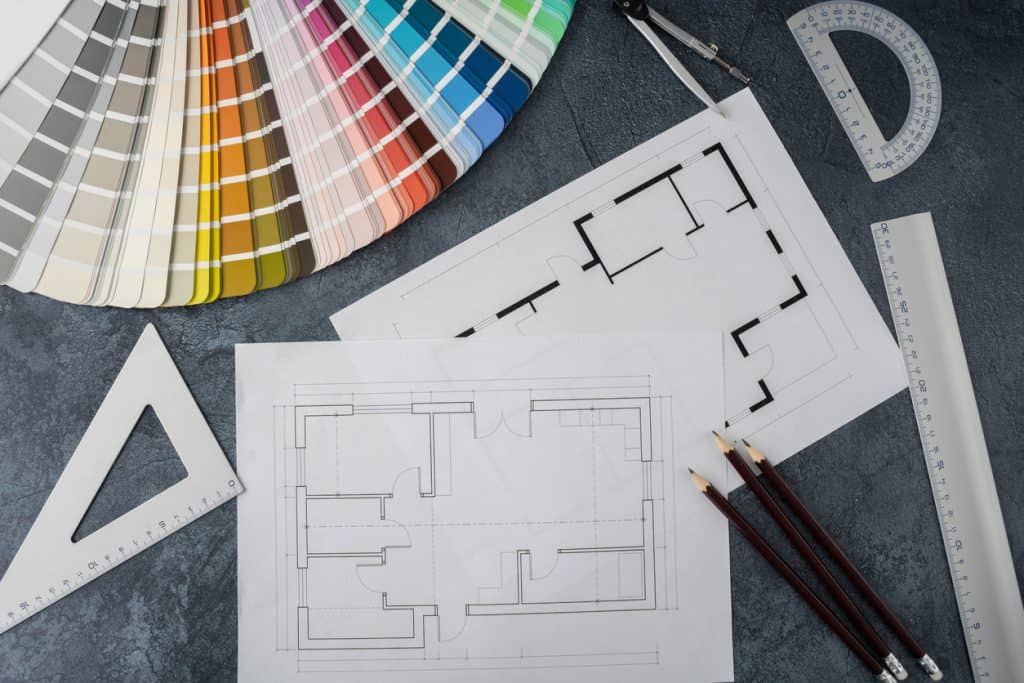
Home floor plans or structural building blueprint project and open color scheme palette guide catalog with colour swatches. Architect or interior design concept. Choosing paint colors for house, flat or apartment.
How to Audit Your Current Palette for Timeless Potential
Step 1—Inventory Fixed vs. Flexible Color Commitments
Grab a pen. Walk your project and categorize every colored surface:
Fixed (hard/expensive to change):
- Flooring and wall base
- Casework and millwork (especially TFL)
- Stone countertops and backsplashes
- Tile in restrooms or feature walls
Flexible (easy/affordable to swap):
- Paint on walls and ceilings
- Upholstery and window treatments
- Artwork and accessories
- Removable wallcovering
Now highlight any trendy colors trapped in the “fixed” category. That blush-pink TFL you specified in 2022? That’s your vulnerability. The sage-green accent wall you painted last month? That’s an easy fix when tastes shift.
Step 2—Run the “Five-Year Test”
For each fixed-category color, ask three questions:
- Would this palette photograph well in 2030?
- Does it support multiple furniture and décor swaps without clashing?
- Will it still align with brand identity after leadership changes or mergers?
If you get two “yes” answers, you’re safe. One “yes”? Proceed with caution. Zero? Start planning the replacement budget now.
The five-year test isn’t about predicting the future—it’s about stress-testing durability. Neutrals, classic woodgrains, and psychology-driven blues and greens pass easily. Ultra-saturated jewel tones and hyper-specific “designer” shades often fail.
Step 3—Score Against Psychology + Brand + Trend
Create a simple three-column scorecard for your palette:
- Psychology: Does this color support intended user behavior (focus, calm, energy)?
- Brand: Does it reinforce client identity and values?
- Trend: Is there a strategic reason (not just fear of missing out) to include it?
If a color scores “yes” on psychology and brand, trend becomes a bonus, not a driver. If it only scores on trend? Cut it or downgrade it to the flexible category. You’re designing for function and identity first, fashion third.
This exercise clarifies decision-making and gives you a clear rationale to present to clients. “We chose this blue not because it’s trending, but because it enhances focus in your data-analysis team’s workspace. The trend simply confirms we’re on the right track.”
Practical Moves: Pivot from Trend-Chasing to Timeless Execution
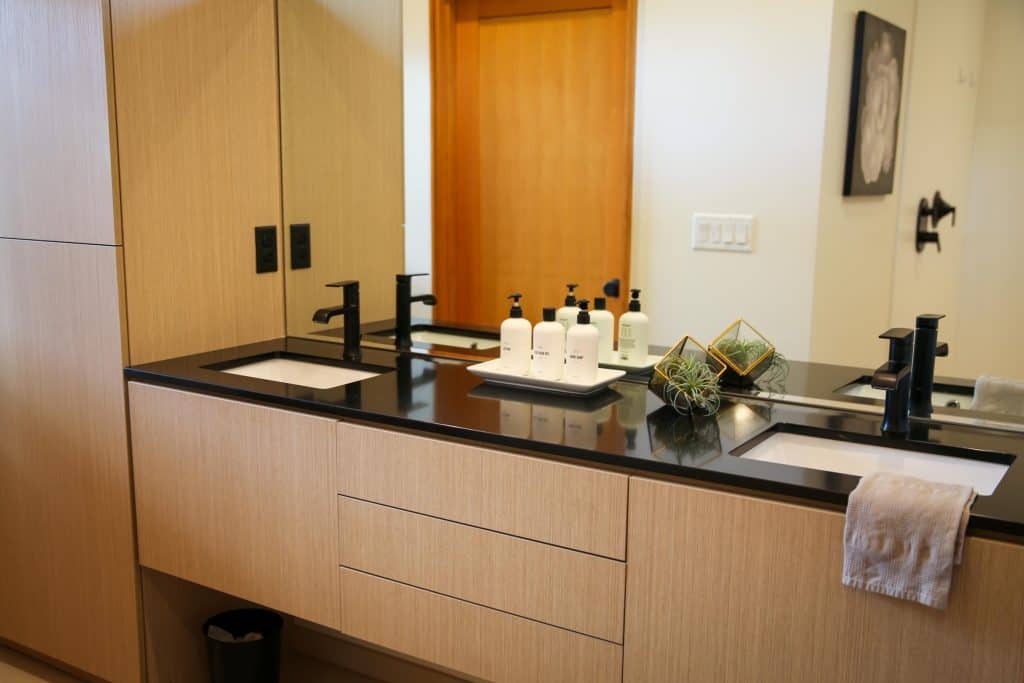
Swap Trendy TFL for Classic Woodgrains and Neutrals
Thermally Fused Laminate is the unsung hero of timeless commercial interiors. It’s durable enough to outlast a dozen paint refreshes, available in hundreds of patterns, and cost-effective compared to veneer or solid surface. But that versatility is a double-edged sword—you can specify a trendy TFL, which means you might.
Don’t. Reach for the classics instead: medium walnut, white oak, charcoal linen, warm gray. These finishes pair with virtually any accent palette, read as high-quality without screaming a specific era, and age gracefully. KML Designer Finishes curates collections specifically for longevity over novelty. Their team understands that specifiers need surfaces that deliver “quality without compromise” and “surface plus substance”—not just this season’s buzzword finish.
When a client pushes for a trendy TFL (“Everyone’s doing burnt orange!”), counter with a neutrals-plus-accents strategy. “Let’s use a warm walnut TFL on the casework—it complements burnt orange beautifully and gives you flexibility to pivot to sage or navy down the road. We’ll bring in the orange through paint and upholstery, so you’re not locked in.”
Use Paint and Textiles as Your Trend “Release Valve”
If you or your client can’t resist the siren song of 2025’s color du jour, contain it. Paint an accent wall. Upholster a lounge chair. Commission custom pillows. Keep the structure neutral and let the trend live in the layer you can peel off and replace when the mood shifts.
This “release valve” approach satisfies the itch for newness without jeopardizing long-term cohesion. A tech campus might rotate its café accent color every three years—cobalt, then terracotta, then forest green—while the neutral TFL millwork and greige walls remain constant. Employees perceive a refreshed environment. The CFO sees a modest soft-goods budget instead of a six-figure gut-rehab.
Budget-conscious clients especially appreciate this model. Painting costs pennies per square foot. Ripping out casework costs dollars per square foot. One is a line item. The other is a capital project.
Educate Clients with a “Timeless + Trend” Matrix
Clients often chase trends because they fear looking outdated, not because they genuinely love the color. Your job is to reframe the decision as strategic, not aesthetic.
Present two palettes side by side:
Option A—Timeless Foundation:
- Neutral walls (greige, soft white)
- Classic TFL casework (walnut, charcoal)
- Psychology-driven accent (blue for focus, green for wellness)
- Projected lifespan: 10–15 years
- Cost per year: $X
Option B—Trend-Forward:
- 2025 trending wall colors (warm terracotta, deep plum)
- Coordinating TFL in seasonal hues
- Accent colors from current forecasts
- Projected lifespan before refresh: 3–5 years
- Cost per year: $X × 2 or $X × 3
The math speaks for itself. Timeless delivers better ROI and lower hassle. If the client still wants Option B, at least they’re choosing consciously and you’ve documented your recommendation. More often, they’ll take Option A and thank you for saving them from their own FOMO.
When (and How) to Strategically Use 2025 Color Trends
Trend-Appropriate Contexts
Not every project demands timelessness. Some environments benefit from riding the trend wave:
- Retail pop-ups and seasonal displays: Built for six-month lifespans; trends boost relevance.
- Co-working lounges: High churn rate; users expect fresh, Instagram-worthy backdrops.
- Hotel lobby accent zones: Hospitality thrives on newness; budgets often include regular refreshes.
- Restroom or corridor accent walls: High-traffic, low-interaction zones where repainting is straightforward.
In these contexts, leveraging BEHR’s 2025 commercial forecast or similar guidance makes sense. You’re designing for immediate impact, not decade-long durability. Just be transparent with the client about the refresh timeline.
The “Test Drive” Approach
Unsure if a trendy hue has staying power? Pilot it in one area before rolling it out campus-wide. Paint a single conference room. Upholster one lounge cluster. Install trending TFL on a single millwork element, not an entire floor of casework.
Live with it for twelve months. Gather feedback. If users love it and it still feels appropriate, consider broader adoption. If it already feels dated or generates complaints, pivot during the next phase. This iterative approach caps your risk while keeping the client engaged and experimental.
Document your reasoning in design presentations. “We’re testing this sage accent in the third-floor break room to gauge response before specifying it in the new wing. If it proves timeless, we’ll expand. If not, we’ve only invested in one room.” Clients respect that thoughtfulness—and you’ve built in a graceful exit strategy.
Document Your Reasoning
Whether you embrace or reject a trend, write it down. Include a brief trend-versus-timeless rationale in your presentation deck, specification notes, or design narrative.
Example: “We selected Storm Blue for the training rooms because research shows blue enhances focus and information retention. While Storm Blue aligns with 2025 color forecasts, our primary driver is occupant performance, ensuring this choice remains relevant beyond the trend cycle.”
This documentation serves three purposes: it educates the client, it protects you if tastes shift, and it positions you as a strategic partner who thinks in systems, not swatches. Designers who articulate why earn trust and repeat business. Designers who shrug and say “it’s what’s trending” become disposable.
FAQs
What are the 2025 color trends everyone’s talking about?
Forecasts emphasize warm, earthy palettes—think deep greens, terracotta, rich browns, and jewel tones like plum. Benjamin Moore’s Cinnamon Slate and similar heathered neutrals lead the pack. Biophilic, nature-inspired hues dominate as designers react to post-pandemic wellness priorities. These replace the cool grays that ruled 2022–2024.
How do I convince a client to skip trendy colors?
Show ROI. Present cost-per-year comparisons between timeless and trend-forward palettes. Emphasize brand consistency and reduced renovation frequency. Offer a “trend release valve” strategy—neutral structure, swappable accents—so they get novelty without risk. Most clients choose longevity when you frame it as smart business, not boring design.
Can I use bold colors and still achieve timelessness?
Absolutely. Navy, forest green, charcoal, and even burgundy have decades of staying power if they’re grounded in psychology and brand, not fleeting fashion. The key is why you’re specifying bold. “Bold for Instagram” ages poorly. “Bold to reduce eye strain in a creative studio” endures.
What color palettes are truly timeless for commercial interiors?
Warm and cool neutrals (greige, taupe, charcoal, soft white), classic woodgrains (walnut, oak, maple), and psychology-backed accent colors (blue for focus, green for wellness, warm earth for hospitality). These transcend trend cycles because they respond to human needs and architectural fundamentals, not cultural fads.
How does TFL fit into a timeless color strategy?
TFL’s durability makes it a perfect timeless anchor—but only if you spec enduring finishes. Choose classic woodgrains or solid neutrals for casework, millwork, and surfaces with fifteen-plus-year lifespans. Save trendy hues for paint and textiles. TFL’s consistency and cost-effectiveness reward patience, not panic.
Conclusion
Chasing 2025 color trends delivers short-term thrill and long-term regret. The spaces that endure—the ones clients cherish and budgets reward—are built on strategy, not swatches. They marry color psychology with brand identity, match palette longevity to material lifespan, and reserve trend experimentation for the layers you can afford to replace.
Timeless doesn’t mean boring. It means intentional. It means specifying a walnut TFL casework system that looks as sophisticated in 2035 as it does today. It means painting accent walls sage because green reduces stress, not because a forecast said so. It means designing for the life of the space, not the length of the forecast.
Invest in surfaces that reward patience. Build palettes that flex without breaking. And the next time a paint company declares a new “color of the year,” smile, nod, and get back to work on projects that will outlast a dozen more announcements.